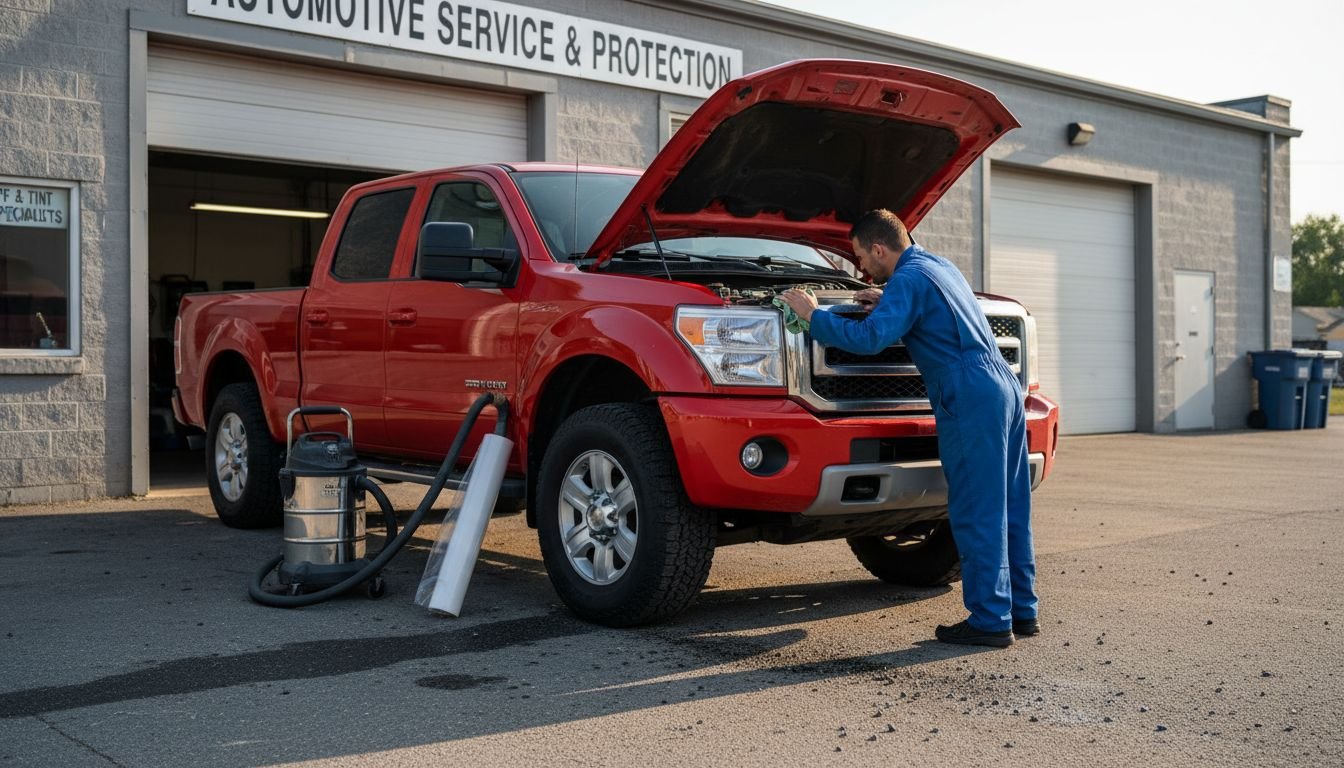
Setting accurate prices for window tinting can feel like chasing a moving target when material expenses and labour costs shift from job to job. Mastering true cost calculation is vital because even small errors can erode your profit and make you less competitive. With labour costs often accounting for the majority of manufacturing expenses, a clear, detail-oriented pricing approach gives you real confidence in every quote and keeps your business strong in any market.
Table of Contents
- Step 1: Assess Material And Labour Costs Comprehensively
- Step 2: Evaluate Vehicle Types And Job Complexities
- Step 3: Research Competitor Pricing And Market Rates
- Step 4: Calculate Desired Profit Margins Clearly
- Step 5: Verify Pricing Accuracy Against Target Market
Quick Summary
| Essential Insight | Detailed Explanation |
|---|---|
| 1. Document All Material Costs | Track every expense associated with tint jobs, including small consumables, to avoid underpricing your work. |
| 2. Assess Labour and Job Complexity | Categorise vehicles by type and complexity to allocate accurate labour estimates and avoid underquoting simpler jobs. |
| 3. Research Competitor Pricing | Gather intelligence on local competitors’ prices to position your pricing strategy effectively within the market. |
| 4. Calculate Necessary Profit Margins | Understand your gross margin requirements and ensure your pricing covers all direct and indirect costs effectively. |
| 5. Validate Pricing Against Market Demand | Test your pricing with actual customers to ensure it meets market expectations and remains competitive within your target segment. |
Step 1: Assess material and labour costs comprehensively
Your pricing strategy collapses without understanding your actual costs. This section walks you through identifying every expense tied to materials and labour so you can price confidently and protect your margins. You’re not guessing anymore—you’re working with real numbers.
Start by documenting every material cost associated with a single tint job. This means the film itself, adhesive promoters, cleaning solutions, and those small consumables that vanish throughout the day (microfiber cloths, squeegees, safety glasses for customers). Many installers underestimate these hidden costs because they seem insignificant individually. Track them for one month. You’ll be surprised. Next, measure your labour investment per vehicle type. A sedan takes different time than an SUV with panoramic glass. Labour costs significantly influence your industry’s competitiveness, which means accurately tracking what you spend on wages and benefits directly affects your ability to price competitively. Record how long each job stage takes: initial consultation, surface preparation, film application, finishing work, and quality inspection. Include setup and cleanup time—these aren’t free activities. Don’t forget that experienced installers deserve higher wages than apprentices, so segment your labour data by skill level.
Now factor in the indirect costs that support your installation work. Facility costs divide across your annual job volume. Equipment maintenance, vehicle bay upkeep, utilities, and tool depreciation all belong in your calculation. If you haven’t tracked these separately, pull together your last twelve months of business expenses and allocate them proportionally to tinting work. Insurance, licensing, and training costs matter too. Some shops overlook these entirely, which means they’re systematically underpricing their work. Create a spreadsheet where you list material costs per vehicle type, labour hours per vehicle type, and your allocated overhead per job. This becomes your baseline. You can now calculate your true cost per installation rather than relying on industry averages that might not match your specific operation. The precision here directly impacts your profitability—there’s no compensation for fuzzy math later.
One practical insight many installers discover: your labour costs might exceed material costs significantly. Across manufacturing sectors, labour typically represents 65 to 70 percent of conversion costs, which means understanding your wage structure and productivity rates determines whether a job actually generates profit or just looks busy. This reality should shape how you think about efficiency improvements and staff development.
Professional tip Calculate your fully loaded cost per hour by dividing total annual expenses (materials, labour, overhead, insurance) by billable installation hours, then use this figure as your pricing floor rather than relying on time-and-materials estimates that leave money on the table.
Step 2: Evaluate vehicle types and job complexities
Not all tinting jobs are equal, and your pricing needs to reflect that reality. This step teaches you how to categorise vehicles by type and complexity so you can assign accurate labour estimates and material requirements to each job. Understanding these differences prevents you from leaving money on the table when handling premium or challenging work.
Start with vehicle classification. A compact hatchback requires far less material and labour than a full-size SUV with panoramic glass. Sedans fall somewhere in between, but they’re not all identical either. Document the specific vehicles you tint most frequently and measure your actual time investment for each category. Measure from the moment you start surface preparation through to final quality checks. Record sunroof tinting separately because it demands distinct techniques and adds significant labour time. Trucks present their own challenge because of large rear windows and potential cab configurations. Once you’ve established baseline labour times for your core vehicle categories, you can apply those benchmarks to similar vehicles in the future. Vehicle size and window complexity significantly impact tinting costs, particularly because larger vehicles require more material and skilled labour to navigate intricate window shapes and curves.
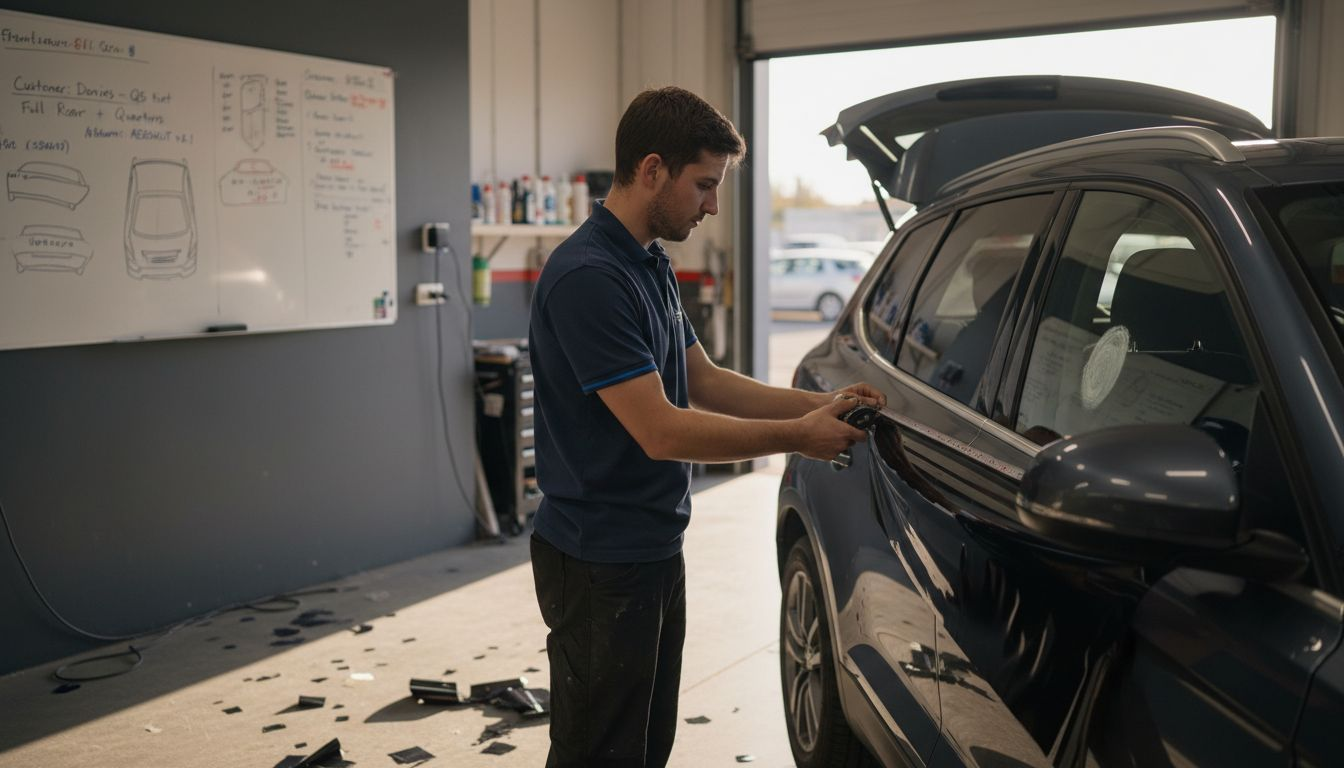
Now assess job complexity beyond vehicle type alone. Standard full window tinting differs drastically from partial applications or custom patterned work. Multi-layer applications using different film types increase complexity exponentially. Consider also whether the customer requests ceramic film (higher labour skill required), carbon film, or basic dyed film. Each film type handles differently during application and demands different preparation protocols. Custom sunroof work or wrapping around specific trim pieces requires problem-solving that your entry-level installers cannot perform efficiently. Luxury and larger vehicles with intricate curves require skilled labour and premium film materials, which means your pricing structure should clearly distinguish between standard jobs and premium installations. Build a complexity matrix in your spreadsheet with low, medium, and high complexity categories. Map each vehicle type into these categories based on your actual experience. A high-complexity job might be a luxury SUV with panoramic glass, custom ceramic tint, and roof treatment. A low-complexity job might be a standard sedan with basic dyed film on side and rear windows only.
The practical impact of this evaluation is that your labour allocation per job becomes precise. You stop underquoting jobs that look straightforward but develop complications mid-installation. You identify which jobs your senior installers should handle versus which ones your team can delegate to less experienced staff. You also recognise when a customer’s requests exceed your shop’s capabilities, which allows you to either adjust pricing upward or refer the work elsewhere. This systematic approach transforms vehicle evaluation from a guessing game into a strategic pricing tool.
Here is a summary of how vehicle type and job complexity impact tinting costs and labour requirements:
| Vehicle Category | Typical Job Complexity | Labour Requirement | Material Cost Impact |
|---|---|---|---|
| Compact Hatchback | Low (standard windows) | Short installation time | Lowest requirement |
| Sedan | Medium (some variations) | Moderate, varies by trim | Moderate spend |
| SUV with panoramic | High (curved/glass roof) | Extended and skilled work | Major increase |
| Luxury/Custom | High (custom film/trim) | Senior installer needed | Premium materials |
Professional tip Create a photo library of vehicles you’ve tinted, labelled by type and complexity category, then use these as reference materials during consultations to accurately scope jobs before committing to a price.
Step 3: Research competitor pricing and market rates
You cannot price intelligently without understanding what others charge in your market. This step shows you how to gather competitive intelligence and interpret market data so you can position your pricing strategically. You’re not copying competitors—you’re learning where the market stands and where you fit within it.
Begin by identifying your direct competitors within your geographic service area. These are shops offering similar tinting services to similar customers, not large franchise operations or mobile tinters operating out of vans. Visit their websites, call them for quotes on standard jobs, and if possible, visit their facilities to observe their operations and pricing displays. Document their pricing for identical vehicle types and film types. Note whether they charge by the hour, by the job, or by the window. Record what they include in their base price and what costs extra (rush fees, custom work, ceramic upgrades). Search online review platforms where customers discuss pricing and value received. This qualitative data often reveals whether competitors are perceived as premium, budget, or mid-market. Check industry forums and tinting communities where installers share market insights. Regional pricing varies significantly due to local labour costs, cost of living, and customer demographics. The global window tint market reflects significant regional pricing variations influenced by labour costs and distribution channels, which means your local market conditions matter far more than national averages. A shop in London operates in a completely different pricing environment than one in rural Wales.
Understand the broader market context by examining product differentiation. Competitive pricing reflects differences between product types such as dyed, ceramic, and metalized films, and your pricing must account for these distinctions clearly. If you offer only basic dyed film, your pricing naturally sits below shops offering premium ceramic options. Customers should understand why your price differs from competitors. Create a comparison table showing what three to five major competitors charge for standard jobs. Include the specific film type, vehicle class, and services included. Analyse patterns. Do they all charge similarly for basic jobs but diverge on premium work? Do established shops charge more than newer operations? Does anyone charge significantly higher, and if so, what justifies their premium positioning? Look for pricing gaps. If most competitors charge between £200 and £400 for a sedan but one charges £600, investigate why. Perhaps they use superior film, offer lifetime warranties, or simply target a different customer segment.
Consider also the psychological pricing strategies competitors employ. Some may use round numbers like £250 or £300. Others might use £249 or £299 to appear more competitive. Some bundle multiple services (tint plus protection film or tint plus ceramic coating). These tactical choices influence customer perception of value. Your research should identify not just competitor prices but the rationale behind them. This positions you to make informed decisions about where you want to sit in the market. Are you competing on price, or are you justifying premium pricing through superior service, better materials, or faster turnaround?
Professional tip Build a spreadsheet comparing competitor pricing by vehicle type and film type, then update it quarterly to track whether the market is moving upward, remaining stable, or becoming saturated in your specific area.
Step 4: Calculate desired profit margins clearly
Profit margins determine whether your business survives or thrives. This step walks you through calculating what margin you actually need based on your business model, then setting prices that deliver those margins consistently. Without this clarity, you’re working blind.
Start by understanding the difference between gross margin and net profit. Gross margin is the percentage of revenue left after subtracting direct costs like materials and labour for each job. Net profit is what remains after all operating expenses, taxes, and debt payments. You need both numbers to make good decisions. Calculate your gross margin by taking your selling price, subtracting your direct costs for that job, then dividing by the selling price and multiplying by 100. If you charge £300 for a sedan tint and your material and labour costs total £120, your gross margin is 60 percent. That looks healthy until you factor in rent, utilities, insurance, vehicle payments, and marketing. Those indirect costs must come from your gross margin. Window tinting businesses typically report gross profit margins between 30 and 80 percent depending on operational scale and efficiency, which means your specific margin target depends on whether you’re a solo operator or running a multi-bay shop with employees.
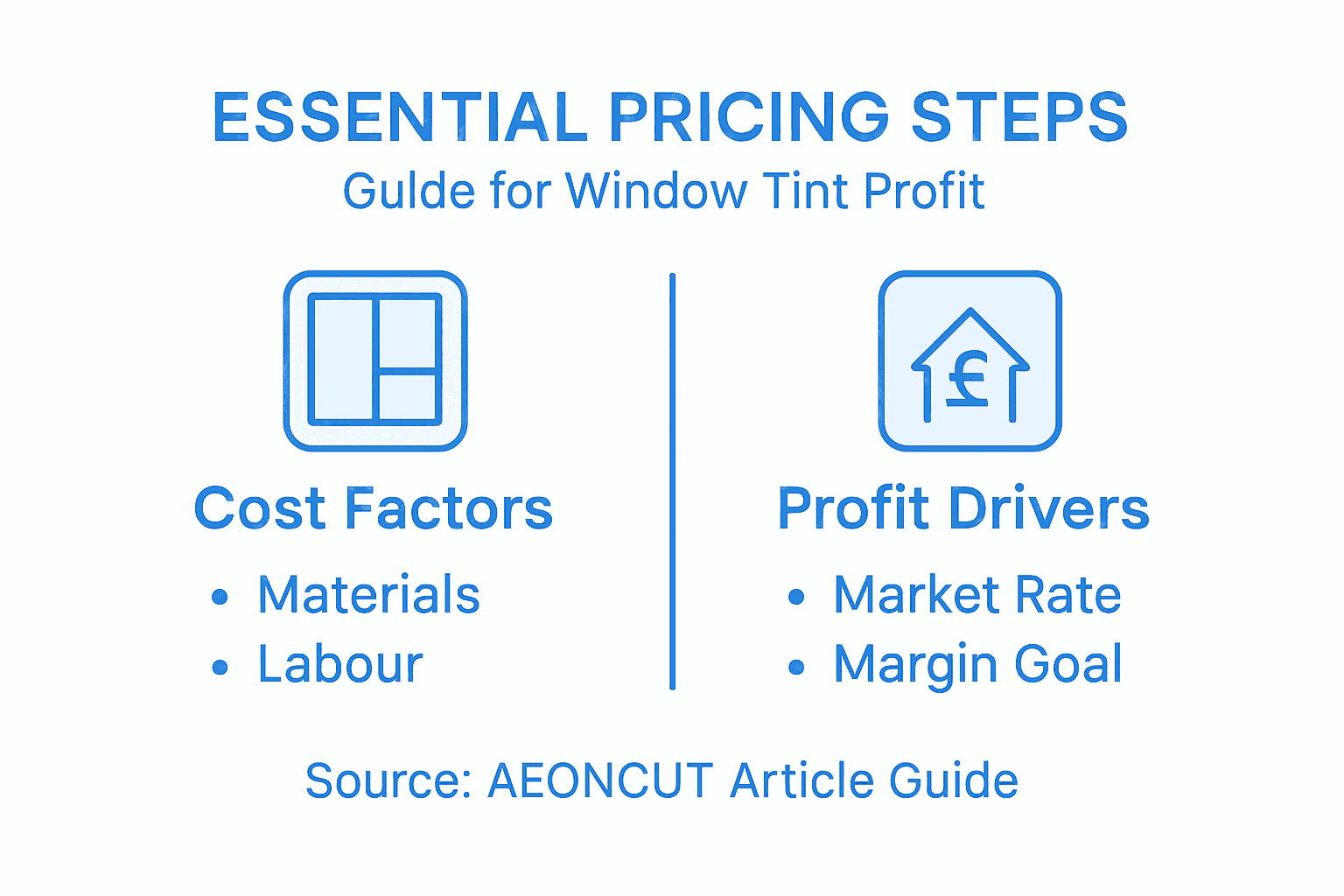
Determine what margin you genuinely need by examining your total operating expenses. Add up everything you spend annually on facilities, staffing, equipment, insurance, licensing, marketing, and administration. Divide this total by your projected annual revenue to find what percentage of your sales must cover overhead. If your annual expenses total £40,000 and you project £120,000 in revenue, overhead consumes 33 percent of your sales. This means your minimum gross margin must exceed 33 percent just to break even. In practice, you need significantly higher margins to build reserves, handle slow seasons, and generate actual profit. Most sustainable tinting shops target gross margins between 50 and 65 percent. This provides a buffer for unexpected costs, allows for promotional pricing occasionally, and creates actual profit to reinvest or take home. If you’re just starting out as a solo operator working from a small space, you can operate at 60 to 70 percent margins. As you hire staff and expand, your margins will naturally compress toward 40 to 50 percent as overhead increases relative to revenue.
Now apply this thinking to specific jobs. Leading operations focus on reducing labour time per job and customer acquisition costs to enhance margin outcomes, which means efficiency improvements directly protect your margins. If you can complete a sedan tint in 2 hours instead of 3 hours whilst maintaining quality, your labour cost per job drops and your margin improves. If you reduce material waste through better technique or software, your cost per job decreases. Track your actual margins on every job type for one month. Calculate what percentage margin you achieved on sedans versus SUVs, on ceramic versus dyed film, on standard versus custom work. Identify which job types deliver strong margins and which barely cover your costs. This data becomes invaluable. You can then adjust pricing on low-margin work, reduce the complexity of certain jobs, or eliminate unprofitable service offerings entirely. The shops that fail are those pricing reactively to customer requests without understanding whether those jobs actually generate the profit they need.
Professional tip Use a simple spreadsheet to calculate gross margin for every job, then review these figures monthly to identify margin trends and spot pricing errors before they accumulate into significant profit leakage.
To clarify profit margin calculations, here’s a reference table explaining key terms and their business significance:
| Term | Calculation Method | Business Significance | Typical Target Range |
|---|---|---|---|
| Gross Margin | (Revenue – Direct Costs) / Revenue | Reveals profit from each job | 30%–80% |
| Net Profit | Revenue minus all expenses | Shows overall business health | 10%–25% |
| Overhead Ratio | Annual Overhead / Annual Revenue | Minimum margin needed to break even | 20%–40% |
Step 5: Verify pricing accuracy against target market
Your pricing strategy only works if it actually resonates with your target customers. This step teaches you how to test your prices against real market demand, validate your assumptions, and adjust before committing fully. You’re moving from theory into practice.
Start by identifying your core target market segments. Are you positioning your business as budget-conscious, mainstream, or premium? Do you serve primarily fleet operators, everyday car owners, or luxury vehicle enthusiasts? Your target market dictates what price points make sense. A premium ceramic tint shop in Central London operates in a completely different market than a budget tint operation in a smaller town. Accurate pricing strategies must align closely with market demand segmented by region, vehicle types, and consumer preferences, which means your prices need to match what your specific customers are willing to pay. Test your proposed pricing by offering quotes to actual prospects over two to three weeks. Track how many quote requests you receive, how many convert to jobs, and what objections customers raise about your pricing. If you’re consistently losing business because customers say you’re too expensive, your prices may exceed what your target market will bear. If every customer accepts your quote without negotiation, you might be pricing too low. Pay attention to these signals. Some price resistance is normal and healthy. Constant pushback suggests a mismatch between your pricing and market expectations.
Examine regional factors that influence pricing tolerance. Customers in affluent areas expect premium service and accept higher prices. Customers in price-sensitive markets require compelling value justification for premium pricing. Local regulations also matter. Some regions require specific film types or prohibit certain tint darkness levels, which constrains your product mix and pricing options. Pricing accuracy improves through benchmarking against global market rates reflecting consumer willingness to pay, regional economic conditions, and availability of advanced technologies, which means understanding your local economic context shapes viable price points. Research whether energy efficiency or UV protection regulations in your area command premium pricing. Some regions have strict regulations that create demand for higher-performing films, allowing premium pricing justified by compliance benefits.
Validate your pricing by tracking customer acquisition cost and conversion rates. Calculate how much you spend in marketing and business development to generate each customer inquiry. If you spend £500 monthly on marketing and generate 10 inquiries, your acquisition cost per inquiry is £50. If only 2 of those 10 convert to actual jobs, your cost per acquired customer is £250. This reveals whether your pricing supports your marketing spend. If you’re acquiring customers expensively but pricing too low to offset that expense, you have a fundamental business problem. Conversely, if your pricing is strong but acquisition costs are high, you might be reaching the wrong audience. Test different price points with different marketing channels. Perhaps your online advertising attracts price-sensitive customers whilst referrals from existing customers skew toward quality-focused buyers willing to pay more. This segmentation helps you optimise both pricing and marketing allocation. After two months of testing, analyse conversion data. Calculate your average job value, conversion rate by price point, and customer satisfaction. If conversion rates drop significantly at higher prices but remain strong at lower prices, you’ve found a market resistance point. If conversion remains stable across price points, you have room to increase pricing. This real-world feedback transforms pricing from guesswork into data-informed strategy.
Professional tip Track every quote you issue alongside the final outcome (accepted, rejected, reason given), then analyse this data quarterly to identify whether your pricing is optimised for your specific market segment.
Enhance Your Window Tint Pricing with Precision and Efficiency
Pricing window tinting jobs accurately is vital for maximising profitability while maintaining competitive advantage. This article highlighted critical pain points such as understanding comprehensive material and labour costs, correctly evaluating vehicle types and job complexities, and setting desired profit margins based on real data. Avoid guesswork and pricing errors by leveraging advanced tools that reduce waste and improve labour efficiency through precise pattern cutting.
Discover how AEONCUT’s window Tint pre-cut cutting software directly addresses these challenges by providing a vast library of exact tint patterns that reduce material waste and speed up installation times. Our cloud-based updates and AI-driven auto-nesting features help professional installers and serious enthusiasts alike achieve consistent, high-quality results with less effort and cost.
Take control of your pricing strategy today by integrating cutting-edge technology with your operations. Visit aeoncutsw.com to explore subscription plans tailored to your business needs and unlock the tools that will turn precise pattern cutting into higher profit margins. For more insights and resources, check out our window Tint category and Uncategorised section. Start transforming your pricing and installation workflow now for maximised profits.
Frequently Asked Questions
How do I accurately assess my material and labour costs for window tinting?
To accurately assess your material and labour costs, document every expense related to your tinting operations, including films, adhesives, cleaning solutions, and indirect costs such as insurance and utilities. Create a detailed spreadsheet and track these expenses over a month to understand your true costs for each job.
What factors should I consider when evaluating vehicle types and job complexities for pricing?
When evaluating vehicle types and job complexities, consider factors such as the size of the vehicle and the intricacy of its windows. Document time spent on each vehicle category and assign different complexity levels to determine how long each job will take and what materials will be required.
How can competitor pricing research influence my window tinting prices?
Researching competitor pricing allows you to understand the market standards and adjust your prices accordingly. Gather data on what similar services charge and consider their offerings to identify gaps in the market where you can position your own pricing effectively.
What profit margins should I aim for in my window tinting business?
Aim for a gross profit margin between 50% and 65% to ensure long-term sustainability and allows for unexpected costs. Calculate your overhead costs and ensure your pricing covers these while still providing the desired profit.
How can I verify if my pricing aligns with my target market?
To verify if your pricing aligns with your target market, test different price points with real customers over a few weeks. Track acceptance rates of your quotes to see if adjustments are needed based on customer feedback and conversion rates.
What tools can I use to calculate my pricing strategy effectively?
Creating a detailed spreadsheet is crucial for calculating your pricing strategy. Include categories for material costs, labour costs, and overhead expenses, and update this regularly to keep track of your financial data and adjust your pricing as needed.
Recommended
- Cost of Window Tinting: 2025 Guide for Installers – AEONCUT PPF Pre-cut Cutting software
- How Window Tint Works: Essential Guide for Auto Professionals 2025 – AEONCUT PPF Pre-cut Cutting software
- Types of Window Tint: Guide for Installers and Dealers 2025 – AEONCUT PPF Pre-cut Cutting software
- Window Tint & PPF Combo Services: How to Maximize Profit – AEONCUT PPF Pre-cut Cutting software