Every seasoned installer knows that tinting a Tesla Model S is nothing like working on conventional luxury cars. The combination of expansive curved glass, integrated sensors, and sophisticated electronics creates unique challenges that expose basic techniques and outdated materials. Failing to account for these factors risks sensor malfunction, unnecessary rework, and wasted film. This guide highlights essential practices and persistent misconceptions whilst sharing professional strategies for reducing material loss and elevating the quality of your Tesla installations.
Table of Contents
- Tesla Model S Tint Essentials And Misconceptions
- Types Of Window Film For Tesla Model S
- Installation Techniques For Minimal Waste
- Legal Tint Limits And Regional Compliance
- Common Mistakes And Prevention Strategies
- Ai-Powered Pre-Cut Solutions For Installers
Key Takeaways
| Point | Details |
|---|---|
| Understand the Limitations of Factory Tint | Factory glass provides inadequate UV and heat protection, requiring aftermarket ceramic or carbon tint to manage excessive solar gain effectively. |
| Select Appropriate Film Technologies | Recommend ceramic films for optimal heat rejection and compatibility with Tesla’s sensors, avoiding dyed and metalised options due to poor performance. |
| Prioritise Compliance with Local Regulations | Be aware of regional VLT limits and ensure clients understand legal restrictions, guiding them towards compliant tint choices. |
| Invest in Quality Installation Techniques | Emphasise thorough surface preparation and the use of pre-cut film kits to minimise waste and ensure high-quality results without rework. |
Tesla Model S tint essentials and misconceptions
Tesla owners often assume that factory glass provides adequate UV and heat protection. This misconception persists because many Teslas come with dyed privacy glass, particularly on rear windows, which creates the visual impression of protection. In reality, factory tint offers minimal heat rejection and insufficient UV blocking. Your clients will likely arrive expecting that their vehicle already has effective thermal management through factory specifications. The truth is more nuanced: without aftermarket ceramic or carbon tinting, the large glass surfaces characteristic of Tesla vehicles allow excessive solar gain into the cabin, resulting in hot interiors and accelerated interior fade. This gap between expectation and reality represents your greatest opportunity to educate clients and deliver tangible value.
Tesla window tinting differs fundamentally from conventional vehicles because of dual-pane windows and integrated sensor systems throughout the glass architecture. When applying tint, you must avoid interference with proximity sensors, rain detection, and automatic wiper systems embedded in the glass layers. Selecting high-quality ceramic films rather than cheaper dyed alternatives prevents signal disruption whilst delivering superior performance. Understanding how window tint works with Tesla-specific technology ensures you recommend appropriate products. The most common installer error involves assuming Tesla glass behaves like standard automotive glazing. It doesn’t. You need certified knowledge of Tesla’s electrical systems and material compatibility to install properly. Poor installation choices damage sensors, trigger warning lights on the dashboard, and create liability issues that damage your reputation.
Another persistent misconception concerns legal compliance. Many installers and vehicle owners believe tint darkness rules apply uniformly across all windows. Actually, regulations vary significantly by jurisdiction, and front side windows typically face stricter restrictions than rear windows. Ceramic tinting appeals to clients seeking both aesthetics and performance, but you must clarify that darkness percentage and thermal rejection are separate variables. A 35 percent ceramic film blocks more heat than a 50 percent dyed film, yet appears darker to the eye. Your expertise in explaining these distinctions separates professional installers from amateurs. Tesla’s minimalist interior design amplifies the visual impact of tint selection, making colour consistency and quality execution visually obvious to owners during everyday use.
Pro tip: Always conduct a detailed consultation with Tesla owners about their specific priorities, whether heat rejection, privacy, or aesthetics, then recommend ceramic films from reputable manufacturers compatible with Tesla sensor systems, and confirm local tint regulations before quoting work.
Types of window film for Tesla Model S
When selecting window film for a Tesla Model S, you’re essentially choosing between four distinct technologies, each with different performance characteristics and installation considerations. Dyed films represent the most basic option, using layers of dye to darken glass. They look good initially and cost less than alternatives, but they offer minimal heat rejection and fade over time when exposed to sunlight. Your clients might initially gravitate toward dyed film because of the lower price point, but this is where your expertise becomes valuable. Dyed films simply cannot deliver the thermal performance Tesla owners expect, particularly given the vehicle’s large glass surfaces that turn the cabin into a greenhouse on hot days. Metalized films reflect solar energy effectively, providing superior heat rejection compared to dyed options. The catch? Metallic particles interfere with cellular signals, GPS, and Tesla’s integrated sensors. This incompatibility makes metalized film a poor choice for modern vehicles with wireless technology. Carbon films occupy the middle ground, combining aesthetic appeal with reasonable performance. They block heat without disrupting electronics, making them a reliable choice for installers who want solid performance without complications.
Ceramic films represent the pinnacle of window tint technology and should be your standard recommendation for Tesla Model S installations. Ceramic films deliver superior heat rejection and UV protection whilst remaining completely transparent to electronic signals. The ceramic particles used in these films are non-metallic, meaning they won’t interfere with proximity sensors, rain detection systems, or any of Tesla’s sophisticated glass-integrated technology. Ceramic films also maintain exceptional clarity, so your clients retain visibility whilst gaining protection. The durability of ceramic films significantly exceeds other options, with many products lasting 10 years or longer without noticeable degradation. Clients investing in a premium vehicle like a Tesla typically understand that quality justifies cost, and ceramic film represents the only rational choice when considering longevity and performance.
The decision between film types fundamentally comes down to your client’s priorities and budget constraints. If heat rejection and sensor compatibility are primary concerns (which they should be for Tesla owners), ceramic film is the only defensible recommendation. If a client insists on cost savings, carbon film provides a reasonable compromise with acceptable performance. Never install metalized film on any Tesla vehicle, regardless of client pressure, because the liability risk far outweighs any short-term profit. Your reputation depends on recommending appropriate products that actually solve client problems rather than creating new ones down the road.
Pro tip: Stock ceramic film from multiple manufacturers so you can offer options at different price points whilst maintaining your recommendation standard, and always explain the sensor compatibility advantage to Tesla owners during consultations.
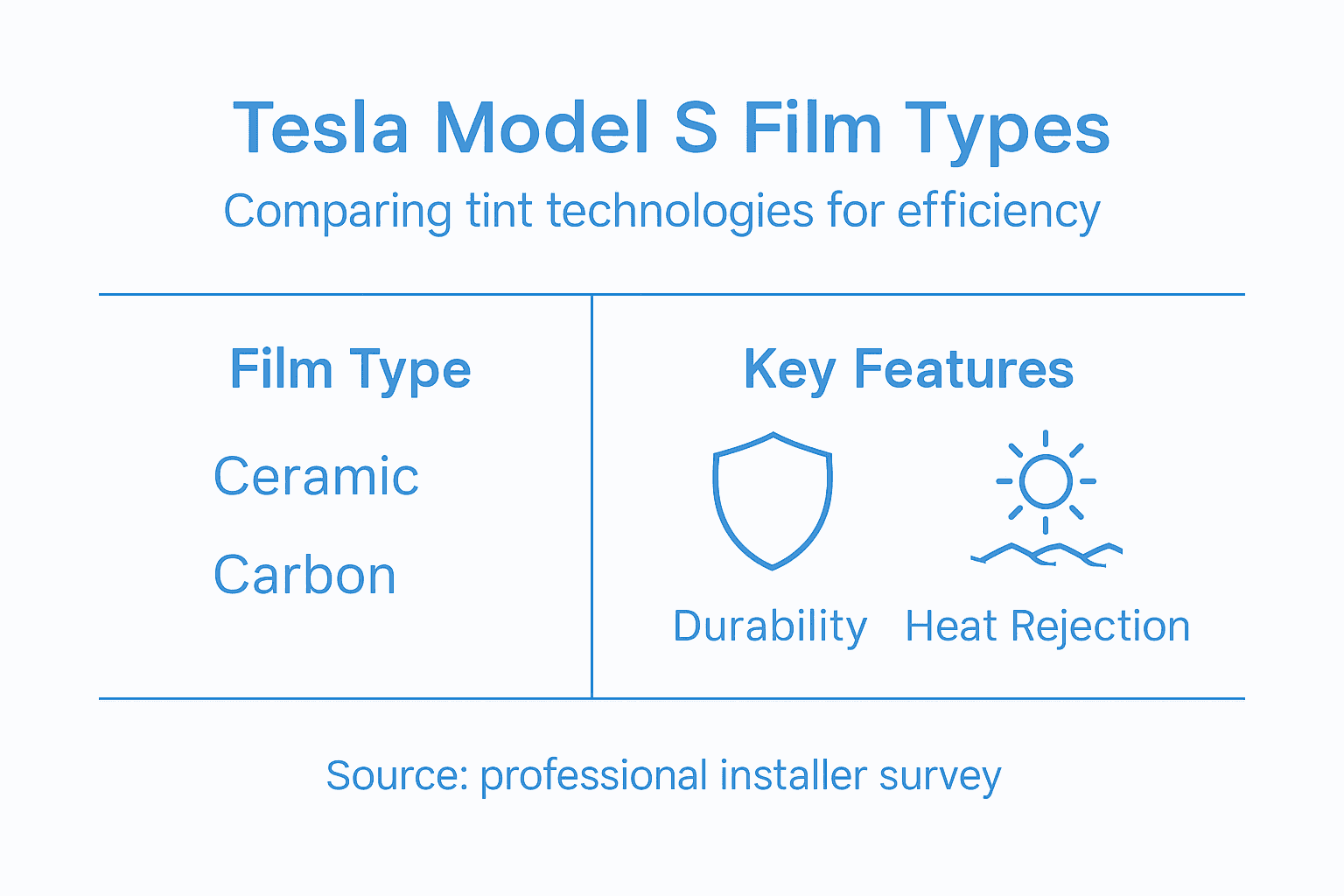
Here’s a concise comparison of the window film types used for Tesla Model S installations:
| Film Type | Signal Interference Risk | Heat Rejection Level | Durability |
|---|---|---|---|
| Dyed | No | Low | Fades and peels quickly |
| Metalised | Yes, disrupts sensors | High | Prone to corrosion issues |
| Carbon | No | Moderate | Stable, long lasting |
| Ceramic | No | Very high | 10+ years, minimal fade |
Installation techniques for minimal waste
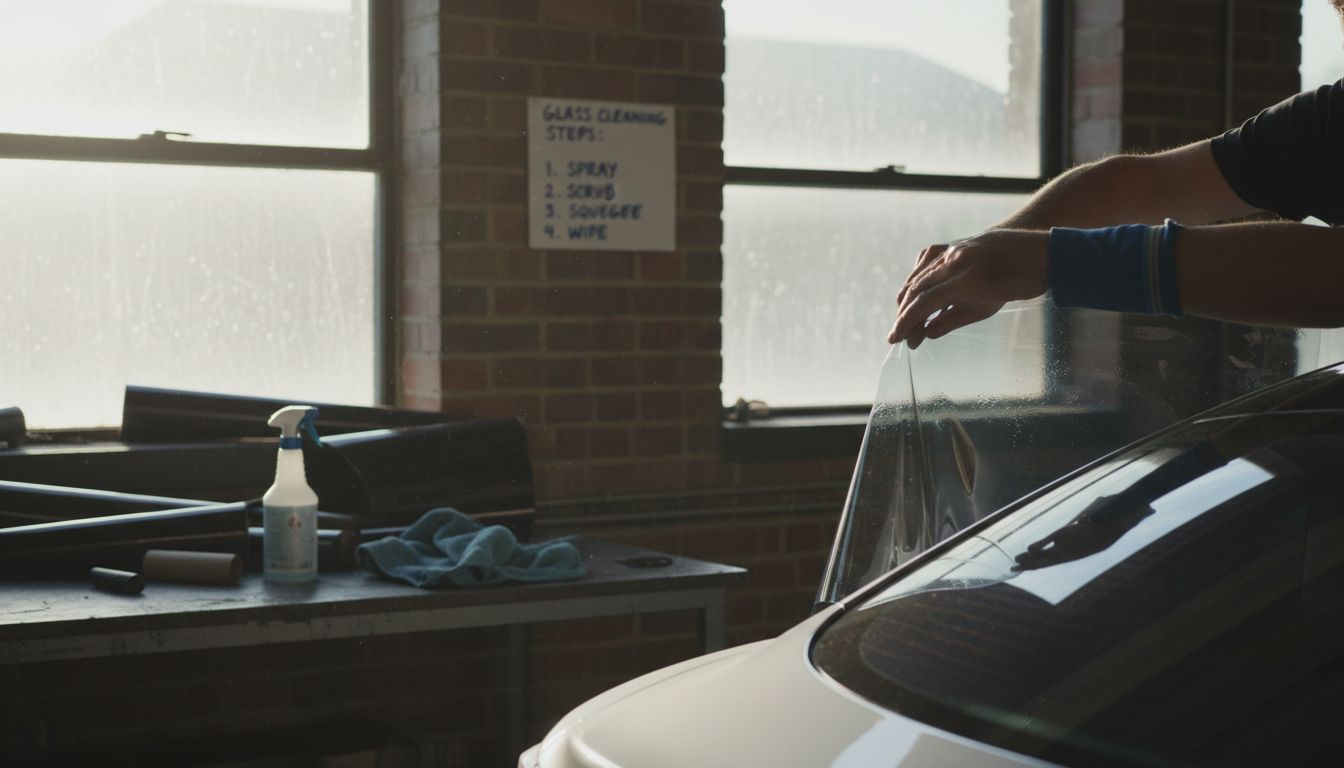
Minimising material waste during Tesla Model S tint installation directly impacts your profitability and sustainability metrics. The foundation of waste reduction starts with thorough surface preparation before any film touches glass. You must clean the windows meticulously using deionised water, a clay bar to remove contaminants, and lint-free cloths to eliminate all residue. Even microscopic dust particles trapped beneath the film create bubbles and adhesion failures, forcing you to strip and reapply the entire section. This preparation phase feels time-consuming, but it prevents costly rework that wastes far more material than the initial cleaning effort. Many installers rush this step, thinking they’ll save time. They don’t. They create problems. Proper cleaning takes fifteen to twenty minutes per vehicle but saves hours of troubleshooting later.
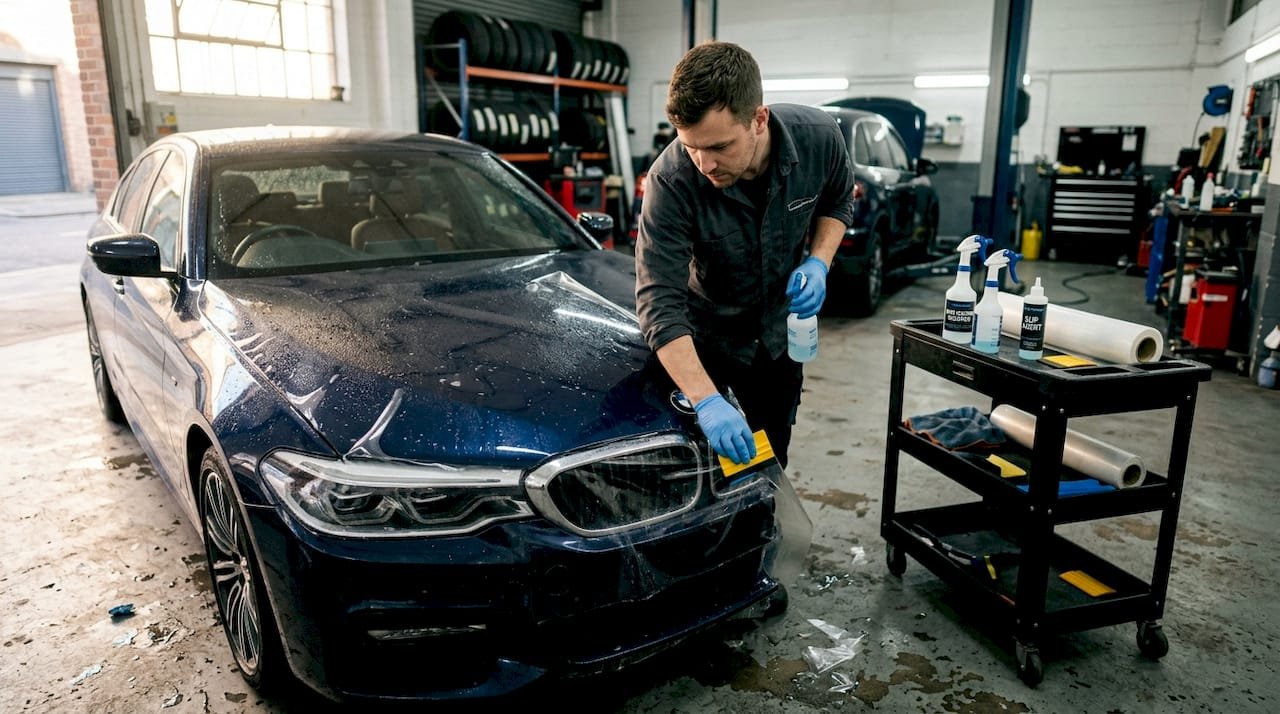
Pre-cut film kits represent your most effective waste-reduction tool. Rather than starting with large sheets and cutting onsite, pre-cut patterns provide precisely sized pieces for each window section. Professional installation using pre-cut films reduces material waste significantly whilst minimising installation errors. Pre-cut designs account for Tesla’s unique glass dimensions and sensor placements, meaning you apply film correctly the first time. Your workflow becomes standardised, repeatable, and efficient. The upfront investment in pre-cut pattern libraries pays dividends across hundreds of installations. When applying pre-cut film, use slip solutions generously to position the material precisely before final adhesion. Slip solution lets you slide the film around, aligning edges perfectly before squeegee pressure bonds it permanently. This prevents costly misalignment that requires removal and reapplication. Apply steady, consistent pressure with your squeegee in overlapping passes, working from the centre outward to eliminate air and moisture. Speed matters less than technique here. Rushing creates bubbles that trap air pockets, compromising both aesthetics and durability.
Handling Tesla’s complex glass geometry demands specific attention to curved edges and sensor areas. Work around proximity sensors, rain detection strips, and speaker membranes with precision, leaving small clearance zones that remain unobstructed. Rather than fighting tight curves with force, use heat guns carefully to soften the film and improve conformability. Excess film trimmed at edges requires sharp blades and steady hands; a single slip wastes material and compromises your edge seal. Consider using a heat shrink technique on particularly complex curves, which allows film to conform naturally rather than stretching and potentially tearing. Your cutting technique during final trimming separates efficient installers from wasteful ones. Clean, confident cuts eliminate rework and material loss.
Pro tip: Invest in AEONCUT pre-cut pattern software for Tesla vehicles to standardise your cutting process, track material usage per installation, and identify efficiency gains across your service volume.
Legal tint limits and regional compliance
Tint regulations exist to balance legitimate privacy and heat rejection benefits against safety requirements for driver visibility. The critical measurement across all regions is Visible Light Transmission (VLT), which indicates the percentage of visible light passing through the tinted window. A 50 per cent VLT allows half the light through, whilst 20 per cent VLT blocks 80 per cent of visible light. Front side windows typically face strict restrictions because drivers must see clearly in all directions to operate vehicles safely. Regional tint regulations vary considerably based on local safety and privacy standards, with most jurisdictions permitting darker tints on rear windows than front windows. Your liability exposure increases dramatically when you install tint darker than local law permits. Clients cannot simply decide they prefer maximum darkness and ignore regulations. Your professional responsibility includes understanding and enforcing compliance.
Most jurisdictions impose front side window VLT limits between 50 and 70 per cent, meaning you cannot legally tint front windows as dark as clients might request. Rear side windows often allow 20 to 35 per cent VLT, providing the darker appearance clients desire for privacy. Rear windscreens typically permit even darker applications, sometimes allowing limo tint at 5 per cent VLT or lower. The windscreen itself usually requires a clear or minimal tint band above the manufacturer’s AS-1 line, and this band must remain non-reflective to avoid interfering with oncoming drivers’ visibility. Failure to comply means clients face fines, forced tint removal at their expense, and potential safety inspection failures. These consequences damage your reputation and expose you to liability claims. You need written documentation of client consent confirming they understand the legal limits you are installing, protecting yourself from disputes about darkness levels.
Tesla’s large glass surfaces create additional complexity because owners want maximum heat rejection and privacy. Unfortunately, no region permits tint darkness that satisfies all client desires simultaneously. Your consultation must clearly explain that darker tint equals reduced legal compliance options. Guide clients toward ceramic films that provide substantial heat rejection without requiring illegally dark VLT percentages. Many clients don’t realise that a properly selected ceramic film at legal darkness levels delivers more effective heat rejection than illegal dyed or carbon film at prohibited darkness levels. The performance difference between legal compliance and non-compliance isn’t as dramatic as clients imagine, yet the legal and financial consequences of violation are severe.
Regulations also vary between countries, states, and sometimes even local municipalities. What’s legal in California differs significantly from European standards, which differ again from Australian regulations. Your professional obligation requires you to research and apply the specific regulations governing your installation location. Never assume regulations are universal or that client requests override local law. Maintaining current regulatory knowledge demonstrates professionalism and protects your business from costly legal exposure.
Pro tip: Create a quick reference chart for your common installation regions showing front window, rear window, and windscreen VLT limits, then reference this during every consultation so clients understand precisely what you can and cannot legally install.
Below is a regional summary of legal VLT limits for Tesla window tinting (example jurisdictions):
| Region | Front Windows VLT (%) | Rear Windows VLT (%) | Rear Windscreen VLT (%) |
|---|---|---|---|
| UK | 70 | No restriction | No restriction |
| California | 70 | 20–35 | 20–35 |
| Germany | 70 | 30 | 30 |
| Australia | 35 | 20 | 20 |
Common mistakes and prevention strategies
The most costly mistakes in Tesla tint installation stem from poor film selection and inadequate surface preparation. Many installers cut corners by using budget dyed films to increase margins, not realising that inferior products create sensor interference, signal disruption, and aesthetic failures that damage reputation far more than the cost savings justify. Low-quality tint films often interfere with Tesla’s integrated electronics including proximity sensors, rain detection systems, and camera arrays essential for driver assistance features. When a client’s windscreen wiper malfunction appears after installation, they connect the dots directly to your work. Warranty voids follow. Negative reviews accumulate. The financial damage exceeds any profit margin advantage from cheap materials. Always specify ceramic or high-grade carbon films from reputable manufacturers. Your brand reputation depends on material quality, not purchasing cost.
Surface preparation represents your second critical vulnerability. Rushing the cleaning phase traps dust, moisture, and contaminants beneath the film, creating bubbles, adhesion failures, and peeling edges within weeks of installation. Professional installers spend fifteen to thirty minutes per window on meticulous cleaning using deionised water, clay bars, and lint-free cloths. This investment prevents callbacks and rework that waste far more time than the initial preparation requires. Premature installation on damp windows introduces trapped moisture that manifests as bubbles and cloudiness over time. Allow adequate drying time between cleaning stages, and install only on completely dry windows. Temperature also matters. Installing tint in cold conditions slows adhesive curing, potentially causing peeling. Follow film manufacturer temperature requirements precisely, as these specifications derive from extensive testing and represent professional standards.
Another prevalent mistake involves choosing unqualified installers unfamiliar with Tesla’s unique architecture. Tesla vehicles feature dual-pane windows, sensor integration, camera systems, and sophisticated glass treatments that differ fundamentally from conventional automobiles. Installers trained only on standard vehicles lack the specialised knowledge to navigate Tesla-specific challenges. Selecting certified Tesla-experienced installation teams prevents warranty voids and sensor damage whilst ensuring professional results. When vetting potential installers, ask specifically about Tesla experience, request examples of previous Tesla installations, and verify their understanding of sensor locations and curing requirements. Documentation matters equally. Always obtain written client consent confirming darkness levels, film type, and legal compliance before beginning work. This protects you from disputes about installation specifications and demonstrates your professionalism.
Curing time violations represent a frequently overlooked mistake. Many installers and clients don’t understand that tint films require specific curing periods, typically 48 to 72 hours depending on product specifications and ambient conditions. Allowing clients to lower windows or expose newly tinted glass to moisture during curing causes edge peeling and adhesion failure. Provide written curing instructions, and consider scheduling follow-up inspections after 72 hours to verify proper adhesion and address any emerging issues before they become warranty claims.
Pro tip: Maintain a written pre-installation checklist covering film type verification, surface preparation protocols, temperature and humidity requirements, sensor location mapping, and curing time specifications, then review this checklist before every installation to eliminate common oversights.
AI-powered pre-cut solutions for installers
Artificial intelligence has transformed how professional installers approach Tesla tint cutting, eliminating the guesswork that previously consumed hours of manual pattern development. Traditional cutting methods required installers to manually measure windows, create templates, and hand-cut each pattern onsite, introducing human error and material waste at every stage. Modern AI-powered cutting software analyses vehicle specifications and glass geometry, then generates precise pre-cut patterns automatically. This technology fundamentally changes your workflow from reactive problem-solving to proactive efficiency. Rather than discovering misalignment during installation, you receive perfectly dimensioned patterns before you ever touch a vehicle.
The practical advantage centres on material conservation and installation speed. Manual cutting typically wastes 15 to 25 per cent of premium ceramic film through trial-and-error trimming and correction cuts. AI auto-nesting algorithms optimise material layout within film sheets, reducing waste significantly whilst maintaining precision tolerances impossible to achieve by hand. When you install forty Tesla vehicles monthly, even modest waste reduction compounds into substantial savings. A 15 per cent waste reduction across forty installations represents hundreds of pounds in saved material costs monthly. Beyond material savings, pre-cut patterns accelerate your installation timeline dramatically. You eliminate measurement, template creation, and test-fitting phases entirely. Installation becomes straightforward application of pre-cut pieces designed specifically for each vehicle’s unique dimensions. This speed translates directly to higher throughput and improved profitability per technician hour.
Tesla-specific AI solutions account for sensor locations, dual-pane window architecture, and critical clearance zones that require precise non-coverage areas. The software maps proximity sensor locations, rain detection strips, and camera arrays, then creates cutting patterns that avoid these components entirely. This eliminates the trial-and-error process of discovering mid-installation that your film positioning interferes with electronics. Your installers apply film confidently, knowing the pattern has already accounted for Tesla’s sophisticated glass integration. Documentation automatically generates for each installation, providing clients with records of what was installed where. This creates accountability and protects you from disputes about pattern accuracy or coverage areas.
Cloud-based AI systems update continuously as new vehicle models and year specifications become available. Rather than waiting for manual pattern development or paying outside contractors for custom cuts, you receive new patterns automatically through software updates. This scalability matters tremendously when you service multiple Tesla variants and generations. Your investment in AI-powered software grows more valuable as your installation volume increases and vehicle diversity expands.
Pro tip: Integrate AI pre-cut pattern software into your workflow by starting with your highest-volume vehicle models, then gradually expand to specialty vehicles as you build confidence in pattern accuracy and installation speed gains.
Enhance Tesla Model S Tinting with AEONCUT’s Precision Software
The challenge of achieving flawless Tesla Model S window tint installations demands expert handling of sensor compatibility, curved glass, and legal compliance as detailed in the article. Professional installers face specific pain points such as avoiding costly sensor interference, minimising material waste, and streamlining complex cuts around Tesla’s unique glass architecture. AEONCUT’s advanced pre-cut cutting software solves these challenges by providing perfectly engineered patterns that account for proximity sensors and dual-pane glass structures while enhancing installation speed and accuracy.
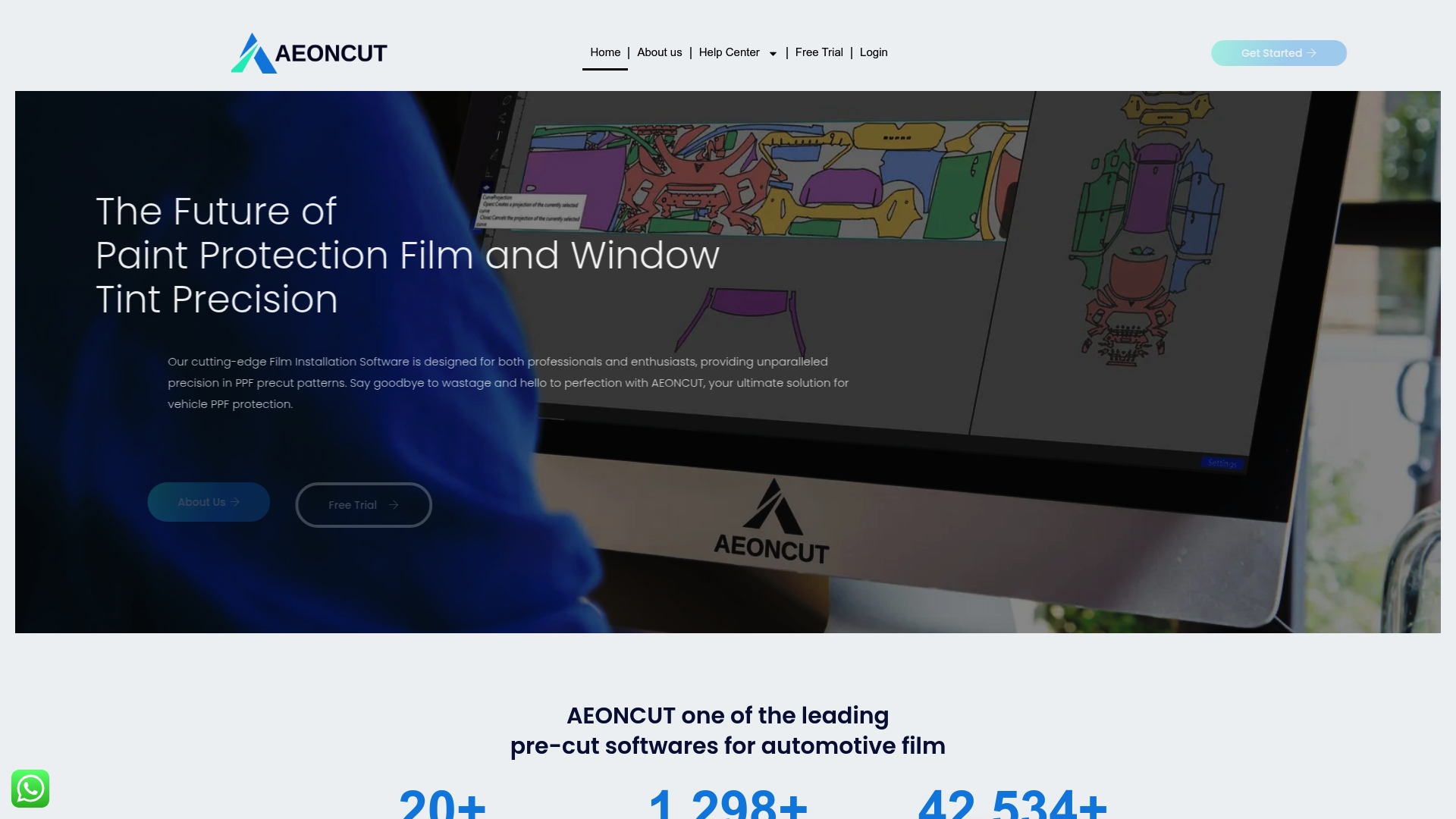
Discover how AEONCUT can elevate your tinting service with features like AI-driven auto-nesting for minimal waste and cloud-based updates for ongoing Tesla model pattern libraries. Visit our window Tint – AEONCUT PPF Pre-cut Cutting software page to explore subscription options tailored for professional installers. Don’t wait until sensor issues or material loss eat into your profits. Act now and experience the future of Tesla Model S tint installation efficiency at https://aeoncutsw.com.
Frequently Asked Questions
What types of window film are available for the Tesla Model S?
There are four main types of window film for Tesla Model S: dyed films, metalized films, carbon films, and ceramic films. Dyed films are inexpensive but offer minimal heat rejection. Metalized films reflect solar energy but can interfere with electronics. Carbon films provide moderate performance without disrupting signals, while ceramic films offer superior heat rejection, UV protection, and compatibility with Tesla’s sensor systems.
How does ceramic window film compare to other types for Tesla vehicles?
Ceramic window film represents the best choice for Tesla owners. It provides very high heat rejection and UV protection, does not interfere with electronic signals, and maintains clarity over time. In contrast, dyed films fade quickly, metalized films disrupt signals, and carbon films offer moderate benefits but are not as effective as ceramic options.
What are the important factors to consider when installing window tint on a Tesla?
Key considerations include thorough surface preparation to minimise dust and contamination, ensuring legal compliance with local tint regulations, and selecting appropriate film types that avoid sensor interference. Understanding Tesla’s unique glass architecture is crucial for proper installation.
How can I reduce material waste during the tint installation process?
To minimise waste, use pre-cut film kits tailored to Tesla’s specifications, which eliminates the need for on-site cutting and reduces errors. Additionally, invest time in meticulous surface preparation to avoid rework, and apply film carefully with proper techniques to prevent bubbles and misalignment.
Recommended
- How Window Tint Works: Essential Guide for Auto Professionals 2025 – AEONCUT PPF Pre-cut Cutting software
- What is Window Tint? Essential Guide for Tinting Pros 2025 – AEONCUT PPF Pre-cut Cutting software
- Types of Window Tint: Guide for Installers and Dealers 2025 – AEONCUT PPF Pre-cut Cutting software
- Cutting Tint: Master the Art of Precision Tinting Techniques – AEONCUT PPF Pre-cut Cutting software
- Value Blinds™ light filtering Roller Shades with Motorization