Many professional installers believe a 35% tint film applied over factory glass automatically results in 35% total VLT, but this widespread misconception leads to costly compliance failures. Visible Light Transmission combines multiplicatively, meaning a 70% factory tint with 50% aftermarket film produces just 35% total transmission. Understanding these cumulative effects, alongside state-specific reflectivity caps and colour restrictions, separates compliant installations from those triggering fines, removal orders, and damaged client relationships. This guide equips you with precise technical knowledge and actionable compliance strategies for navigating 2026’s complex tinting regulations across jurisdictions.
Table of Contents
- Understanding Visible Light Transmission And Its Impact On Tint Compliance
- State Variations And Key Legal Parameters Affecting Vehicle Tinting
- Practical Compliance Tips And Installer Responsibilities For 2026
- Equip Your Tinting Business With Aeoncut Software Solutions
- What Are The Most Common Questions About Vehicle Tint Laws For Installers?
Key takeaways
| Point | Details |
|---|---|
| VLT percentages define legal darkness | Lower VLT numbers indicate darker tints; most states require 32-70% for front windows. |
| Factory and aftermarket films multiply | A 70% factory tint with 50% film results in 35% total VLT, not 50%. |
| Reflectivity limits vary by state | Metallic films often exceed 25-35% caps, making them illegal in many jurisdictions. |
| Medical exemptions require documentation | Patients must carry physician letters; exemptions rarely transfer between vehicle owners. |
| Non-compliance triggers immediate penalties | Fines range £75-£225, with mandatory removal and potential inspection failures. |
Understanding visible light transmission and its impact on tint compliance
Visible Light Transmission indicates the percentage of light passing through window tinting, with lower percentages producing darker tints. A 50% VLT film allows half the visible light through, whilst a 5% film blocks 95% of light, creating the nearly opaque appearance often called “limo tint.” This measurement forms the foundation of every jurisdiction’s tinting regulations in 2026, yet installers frequently misinterpret how these percentages interact with factory glass.
Factory-installed privacy glass typically ranges from 15-20% VLT on rear windows and 70-80% on front windows. When you apply aftermarket film, the VLT values multiply rather than add. Installing a 50% film over 70% factory glass produces 35% total VLT (0.70 × 0.50 = 0.35), not the 120% some clients mistakenly expect. This multiplicative relationship catches inexperienced installers off guard, resulting in installations that appear legal during application but fail roadside inspections.
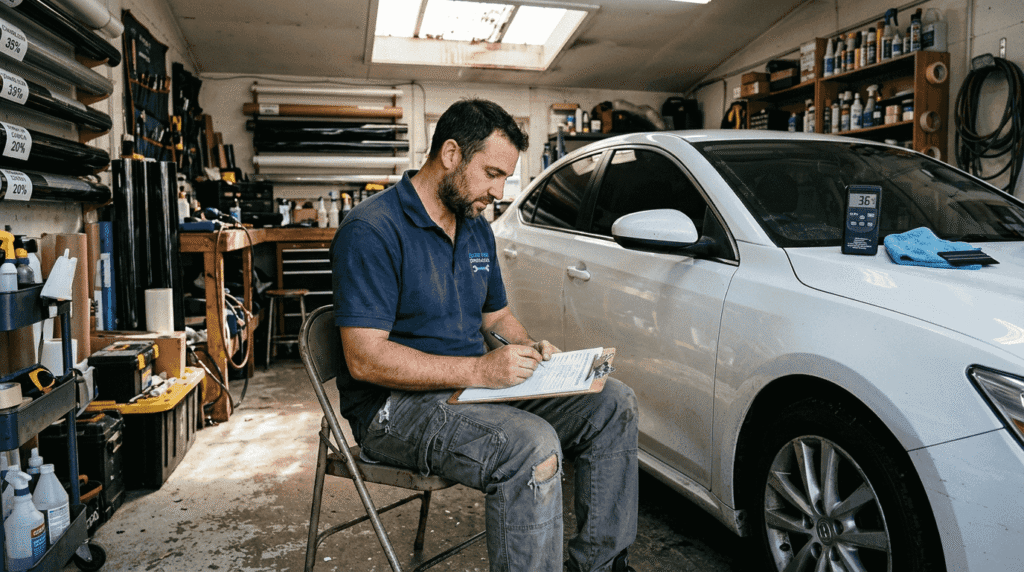
Professional tint meters offer precision within ±2% accuracy when properly calibrated, making them essential for pre-installation measurements and compliance verification. Handheld meters cost £150-£400 and require monthly calibration checks using reference standards. Place the meter flush against the glass, ensuring no air gaps compromise readings. Take three measurements per window and average the results for maximum reliability.
Common installer mistakes include:
- Assuming film percentage equals final VLT without measuring factory glass
- Using uncalibrated meters that drift 5-8% over six months
- Measuring through rolled-down windows instead of closed glass
- Ignoring windscreen tint strips that extend beyond legal zones
Pro Tip: Always measure factory VLT before quoting clients. A vehicle with 60% factory glass needs 53% film to achieve 32% total VLT, whilst 80% factory glass requires 40% film for the same result. This precision prevents comeback jobs and maintains your professional reputation.
“The difference between a compliant installation and an illegal one often comes down to 3-5% VLT. Installers who skip factory glass measurements gamble with their clients’ money and their own liability exposure.” — Industry compliance expert
Mastering VLT calculations transforms your approach to every job. Check our window tinting regulations guide 2026 for jurisdiction-specific requirements, and review large vehicle tint installation guide techniques for commercial applications where compliance stakes run even higher.
State variations and key legal parameters affecting vehicle tinting
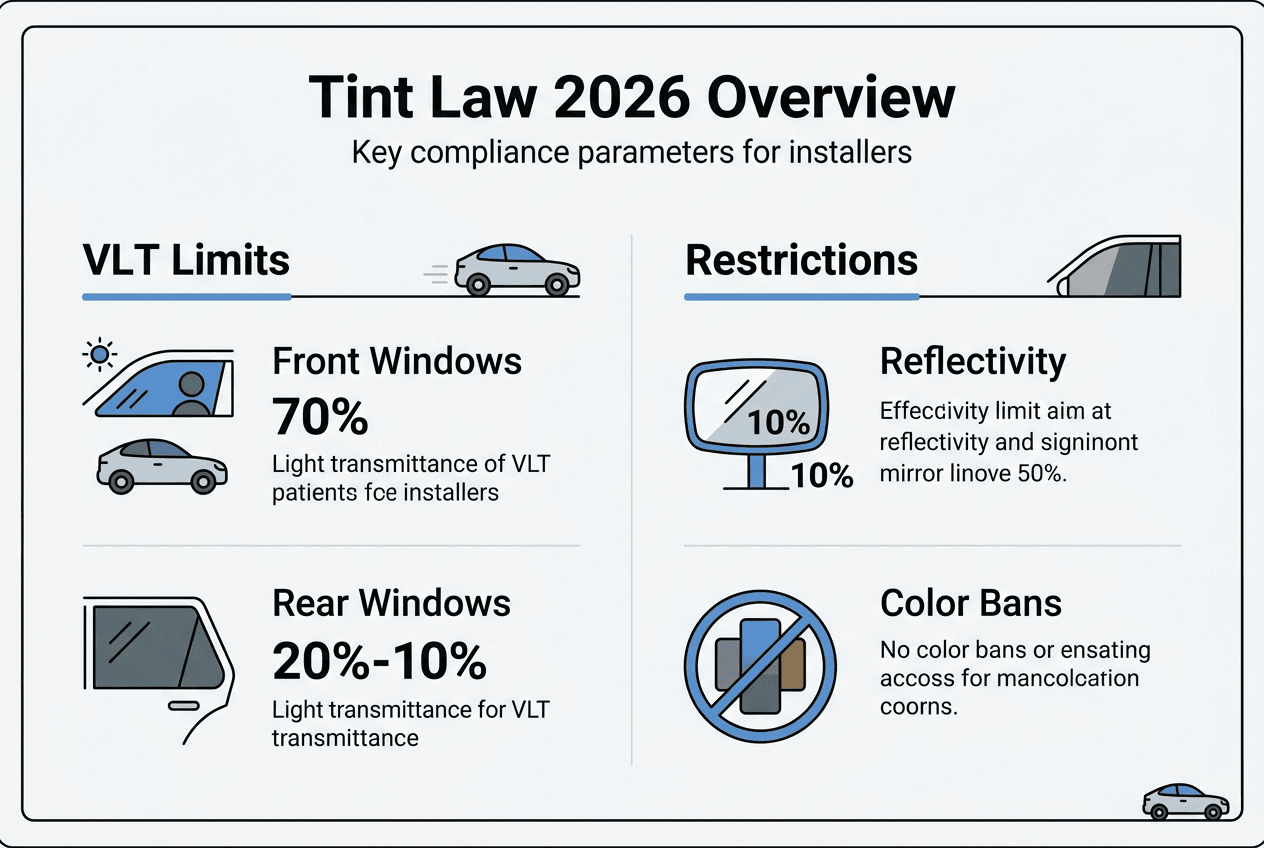
State regulations vary widely with no federal standard governing passenger vehicle window tinting in 2026. California permits 70% VLT on front side windows whilst allowing any darkness on rear windows. Texas requires 25% on front sides, 25% on rear sides, and any percentage on rear windows. Florida mandates 28% front, 15% rear sides, and 15% rear glass. New York enforces 70% on all windows except the rear windscreen. These dramatic differences demand that installers verify local codes before every installation.
Reflectivity restrictions typically cap at 25-35%, directly affecting metallic and mirror-like film selection. Reflective films bounce light away rather than absorbing it, reducing interior heat but creating glare hazards for other drivers. States measure reflectivity as the percentage of light reflected compared to standard glass. A film producing 40% reflectivity exceeds most legal limits, even if its VLT meets darkness requirements. This dual compliance challenge eliminates many high-performance ceramic and metallic products from legal use in specific jurisdictions.
| State | Front Side VLT | Rear Side VLT | Rear Window VLT | Reflectivity Limit |
|---|---|---|---|---|
| California | 70% | Any | Any | None specified |
| Texas | 25% | 25% | Any | 25% |
| Florida | 28% | 15% | 15% | 35% |
| New York | 70% | 70% | Any | None specified |
| Arizona | 33% | Any | Any | 35% |
Colour restrictions ban red, amber, and yellow tints in most jurisdictions because these hues interfere with emergency vehicle light recognition. Some states prohibit reflective or mirrored finishes entirely, whilst others allow them within reflectivity caps. Always verify colour legality before ordering specialty films, particularly for clients requesting custom appearances.
Medical exemptions require documentation from licensed physicians and vary significantly by state. Patients with photosensitivity conditions, lupus, or certain skin cancers may qualify for darker tints than standard limits allow. California issues medical exemption certificates valid for five years, whilst Texas requires annual renewals. These exemptions typically apply only to the registered vehicle owner and don’t transfer with vehicle sales. Installers must keep copies of exemption paperwork for their records, as law enforcement will request proof during traffic stops.
Compliance stickers serve as immediate visual proof of legal installation. Texas law requires a small sticker between the film and glass on the driver’s side window, displaying the installer’s name, address, and certification that the tint meets state requirements. Failing to apply these stickers results in £150 fines for installers, separate from any penalties the vehicle owner faces.
Pro Tip: Create a compliance checklist for each state where you operate. Include VLT minimums, reflectivity caps, colour restrictions, exemption procedures, and sticker requirements. Update this quarterly as jurisdictions modify regulations, and train all installation staff on the current standards.
Key considerations for multi-state installers:
- Border region vehicles may cross jurisdictions daily, requiring compliance with the strictest applicable law
- Commercial fleet clients need uniform tinting that satisfies all operating territories
- Warranty claims increase when clients receive citations in neighbouring states with stricter rules
Explore our car window tint law guide 2026 for detailed jurisdiction breakdowns, review back window tint limit laws for rear glass specifics, and check mirror window tint vehicles regulations before recommending reflective products.
Practical compliance tips and installer responsibilities for 2026
Installers should precisely measure factory VLT to calculate total legal tint and avoid unexpected violations. This process begins before the client arrives, using your calibrated meter to establish baseline measurements for each window requiring film. Record these values in your job documentation, creating a paper trail that protects both you and the client if questions arise later.
Follow this step-by-step measurement protocol:
- Calibrate your tint meter using the manufacturer’s reference standard before starting daily operations.
- Clean the glass thoroughly to remove dirt, oils, and residue that affect readings.
- Place the meter flush against the interior glass surface with no air gaps.
- Take three measurements at different window locations (top, middle, bottom) to account for manufacturing variations.
- Average the three readings and record the result as your factory baseline VLT.
- Calculate the required film VLT by dividing the legal minimum by your factory baseline (e.g., 35% legal ÷ 70% factory = 50% film needed).
- Verify the final installation by measuring through both the factory glass and applied film.
- Document all measurements with photos showing the meter display and window location.
Calculating combined VLT requires understanding the multiplicative relationship between layers. A vehicle with 75% factory glass needs 47% film to achieve 35% total VLT (0.75 × 0.47 = 0.35). Rounding errors accumulate quickly, so use a calculator rather than mental arithmetic. When final measurements fall within 2% of legal minimums, consider using slightly lighter film to create a compliance buffer accounting for meter calibration variations and enforcement tolerances.

Pro Tip: Build a VLT calculation spreadsheet with common factory glass percentages (60%, 70%, 80%) and legal minimums for your operating jurisdictions. This tool speeds quotes and prevents mathematical errors during client consultations.
Advising clients on legal limits protects your business from liability whilst building trust through transparency. Explain that darker isn’t always better, particularly for drivers who frequently travel between states or face regular commercial vehicle inspections. Discuss medical exemption options for clients with legitimate health conditions, providing referral information for physicians familiar with the documentation requirements.
Address Advanced Driver Assistance Systems (ADAS) compatibility during consultations. Window tinting can impact camera-based systems including lane departure warnings, automatic emergency braking, and adaptive cruise control. Sensors mounted behind windscreens or near mirrors may malfunction with certain tint densities or metallised films. Test these systems after installation and document their proper operation.
Failure to comply results in fines from £75-£225 and mandatory removal of illegal tint. Some jurisdictions issue fix-it tickets requiring proof of correction within 30 days, whilst others impose immediate fines with no correction option. Repeat violations escalate penalties and may trigger vehicle impoundment in extreme cases. Commercial vehicle operators face additional Federal Motor Carrier Safety Administration penalties that jeopardise operating licences.
“Every illegal tint installation represents a potential lawsuit waiting to happen. When clients receive citations, they’ll look to their installer for reimbursement, refunds, or removal services. Prevention through proper measurement costs nothing compared to these downstream expenses.” — Automotive legal consultant
Compliance documentation should include dated photos of your meter readings, the film product specifications, any medical exemption paperwork, and signed client acknowledgment of legal limits. Store these records for at least three years to support your defence if disputes arise. Many successful shops provide clients with a compliance certificate listing the VLT percentages achieved and confirming adherence to local regulations.
Learn advanced techniques in our mastering legal window tint limits 2026 guide, and explore efficiency improvements with automatic car tint installers that reduce measurement errors through integrated sensor technology.
Equip your tinting business with AEONCUT software solutions
Navigating the complex web of tinting regulations across jurisdictions demands precision tools that eliminate guesswork and reduce compliance risks. AEONCUT software provides professional installers with accurate pre-cut patterns and integrated compliance guidance, ensuring every installation meets 2026 legal requirements whilst maximising efficiency and minimising material waste.
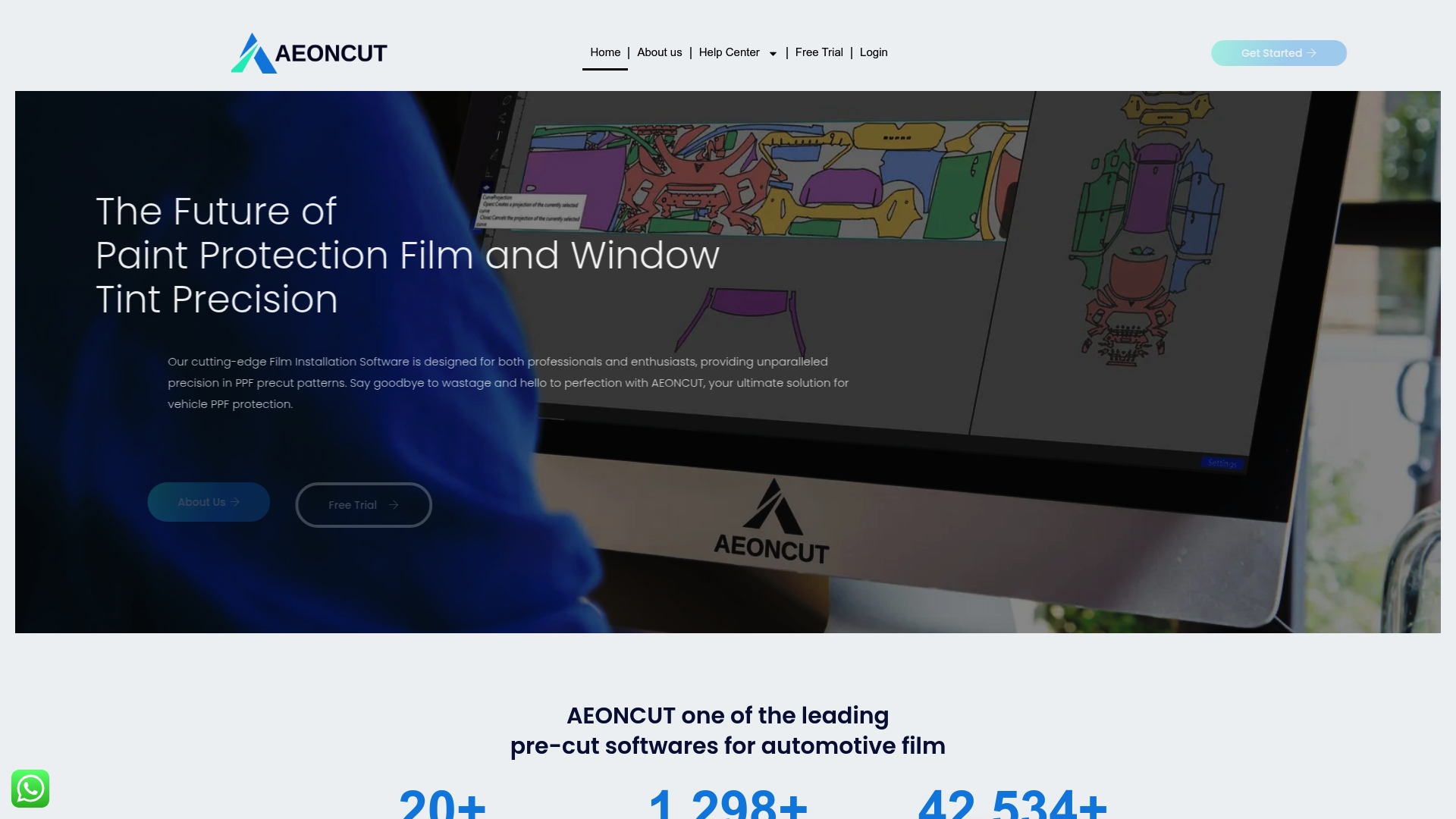
Our platform includes regularly updated window tinting regulations guide 2026 data embedded directly into your workflow, alerting you to jurisdiction-specific VLT minimums, reflectivity caps, and colour restrictions before you cut film. The AI-driven auto-nesting feature optimises material usage whilst our extensive pattern library covers thousands of vehicle makes and models, reducing measurement time and improving first-time installation success rates. Explore our best window tint software 2025 comparison to understand how AEONCUT outperforms competitors, or dive into master window tint cut software techniques that transform your installation quality and speed.
What are the most common questions about vehicle tint laws for installers?
What VLT percentage is legal for front passenger windows in most states?
Most states require 32-35% VLT minimum for front side windows, though this varies significantly. California and New York mandate 70%, whilst Arizona allows 33% and Texas permits 25%. Always verify your specific jurisdiction’s requirements before installation, as these represent the most frequently enforced regulations during traffic stops.
How do factory tints affect the total VLT and legal compliance?
Factory glass VLT multiplies with aftermarket film VLT to determine total transmission. A vehicle with 70% factory glass receiving 50% film achieves 35% total VLT (0.70 × 0.50), not 50%. Measure factory glass before every installation to calculate the correct film percentage needed for legal compliance in your jurisdiction.
Are there exceptions for darker tints due to medical conditions?
Yes, most states offer medical exemptions for patients with photosensitivity conditions, lupus, or certain skin disorders. These require physician documentation and often involve annual renewals. Exemptions typically apply only to the registered owner and don’t transfer with vehicle sales, so advise clients to maintain current paperwork accessible during traffic stops.
Can reflective or coloured tints be legally applied on all windows?
Reflectivity limits typically cap at 25-35% in states that regulate this parameter, whilst many jurisdictions ban red, amber, and yellow tints entirely. Metallic and mirror-like films often exceed these caps even when meeting VLT requirements. Check both darkness and reflectivity regulations before recommending high-performance films, and avoid colours that interfere with emergency vehicle recognition.
What penalties apply if a vehicle fails tint inspection?
Fines range £75-£225 for first violations, with mandatory tint removal required before re-inspection. Some jurisdictions issue fix-it tickets allowing 30-day correction periods, whilst others impose immediate fines. Repeat violations escalate penalties and may trigger vehicle impoundment. Commercial operators face additional federal penalties that jeopardise operating licences, making compliance critical for fleet installations. Review our car window tint law guide 2026 for jurisdiction-specific penalty structures and enforcement patterns.
Recommended
- Car window tint law guide for professional installers 2026 – AEONCUT PPF Pre-cut Cutting software
- Window tinting regulations guide 2026: compliance tips – AEONCUT PPF Pre-cut Cutting software
- Complete Guide to Window Tint Laws 2025 – AEONCUT PPF Pre-cut Cutting software
- Mastering maximum legal window tint limits for 2026 – AEONCUT PPF Pre-cut Cutting software