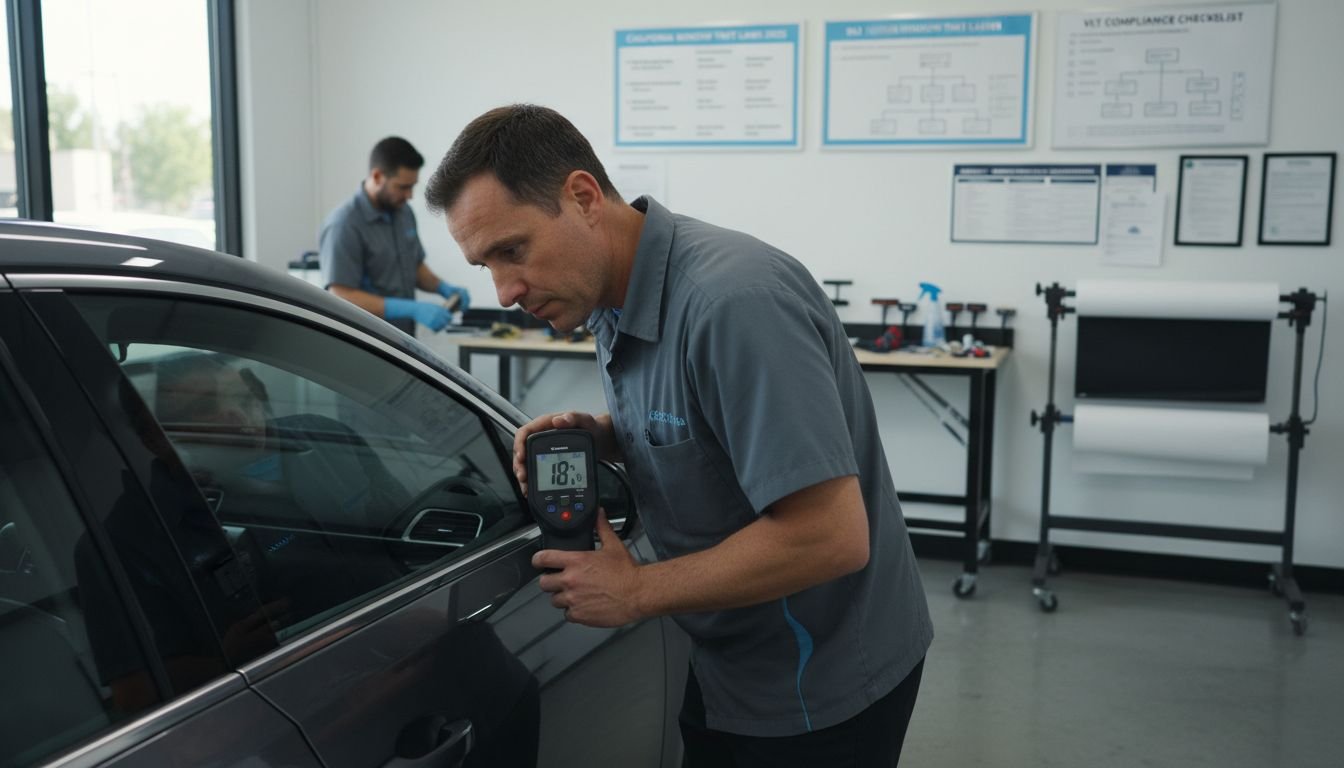
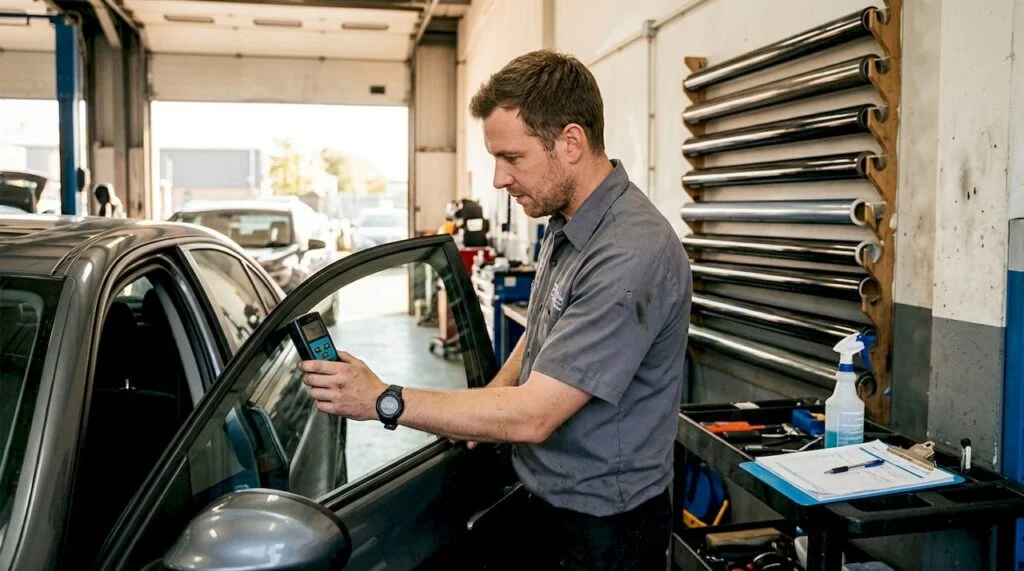
Many automotive professionals believe that tint regulations apply uniformly across all vehicle windows, yet this misconception leads to costly compliance failures and damaged reputations. In reality, tint regulations define specific visible light transmission (VLT) percentages allowed per window according to statute, with distinct limits for front side windows, rear side windows, and back windows varying by jurisdiction. Understanding these nuances is essential for delivering compliant installations, protecting your business from legal penalties, and building client trust. This comprehensive guide clarifies the regulatory landscape, equipping you with practical knowledge to navigate window tint compliance confidently.
Table of Contents
- Key takeaways
- Understanding window tint regulations: what automotive professionals need to know
- Comparing car window tint limits: regulations by window type and jurisdiction
- Tools and techniques to ensure car window tint compliance
- Best practices for advising clients and managing compliance risks
- Enhance your window tinting service with AEONCUT solutions
- Frequently asked questions
Key Takeaways
| Point | Details |
|---|---|
| VLT varies by window | VLT limits differ for front side, rear side and back windows depending on jurisdiction, so installers must tailor compliance to each position. |
| Compliance essential to avoid penalties | Understanding and adhering to local regulations protects businesses from legal penalties and maintains client trust. |
| Verify final VLT on vehicle | Film darkness should be tested on the actual vehicle rather than relying solely on manufacturer specifications. |
| Check model regulations before installation | Always verify the vehicle’s model regulations and factory glass tint before applying film. |
| Annual regulatory refresh required | Legislation and guidance change over time so professionals should refresh their knowledge every year. |
Understanding window tint regulations: what automotive professionals need to know
Visible light transmission (VLT) forms the foundation of all window tint regulations. VLT measures the percentage of visible light passing through window film and glass, with lower percentages indicating darker tints. Regulators use VLT percentages to establish legal limits because they directly impact driver visibility, road safety, and law enforcement ability to see vehicle interiors.
Typical VLT limits vary dramatically by window position. Front side windows commonly require 50% to 70% VLT to maintain driver visibility and officer safety during traffic stops. Rear side windows often permit darker tints, ranging from 20% to 35% VLT in many jurisdictions. Back windows typically allow the darkest films, sometimes permitting any darkness level or requiring only 5% to 20% VLT minimum. These variations reflect safety priorities balancing driver vision with privacy considerations.
Regional legislation creates significant complexity for professionals serving multiple areas. What qualifies as legal in one jurisdiction may trigger penalties in another, making mastering maximum legal window tint limits 2026 essential for cross-border operations. Installers must maintain current knowledge of regulations in every service area to avoid liability.
Tint materials and film darkness directly affect compliance outcomes. Ceramic films, metallic films, and dyed films each interact differently with light transmission measurements. A film labelled 35% by manufacturers may test differently when combined with factory-tinted glass, requiring professionals to measure final VLT rather than relying solely on film specifications. Understanding car window tint limit compliance principles helps prevent installation errors.
Pro Tip: Always verify each vehicle’s specific model regulations before installation to avoid legal issues. Factory glass tint varies between manufacturers and model years, affecting the film darkness you can legally apply.
Critical factors influencing compliance include:
- Factory glass tint percentages that vary by manufacturer and reduce available film darkness options
- Measurement conditions such as temperature and humidity affecting tint metre readings
- Film age and degradation altering VLT over time
- Aftermarket window replacements potentially changing baseline light transmission
- Regulatory updates requiring annual knowledge refreshment
Comparing car window tint limits: regulations by window type and jurisdiction
Professionals operating across multiple regions face a complex patchwork of tint regulations. Understanding these variations prevents costly mistakes and ensures every installation meets local legal standards. Different windows — front side, rear side, back window — have varied legal tint limits depending on jurisdiction, making comprehensive knowledge essential.
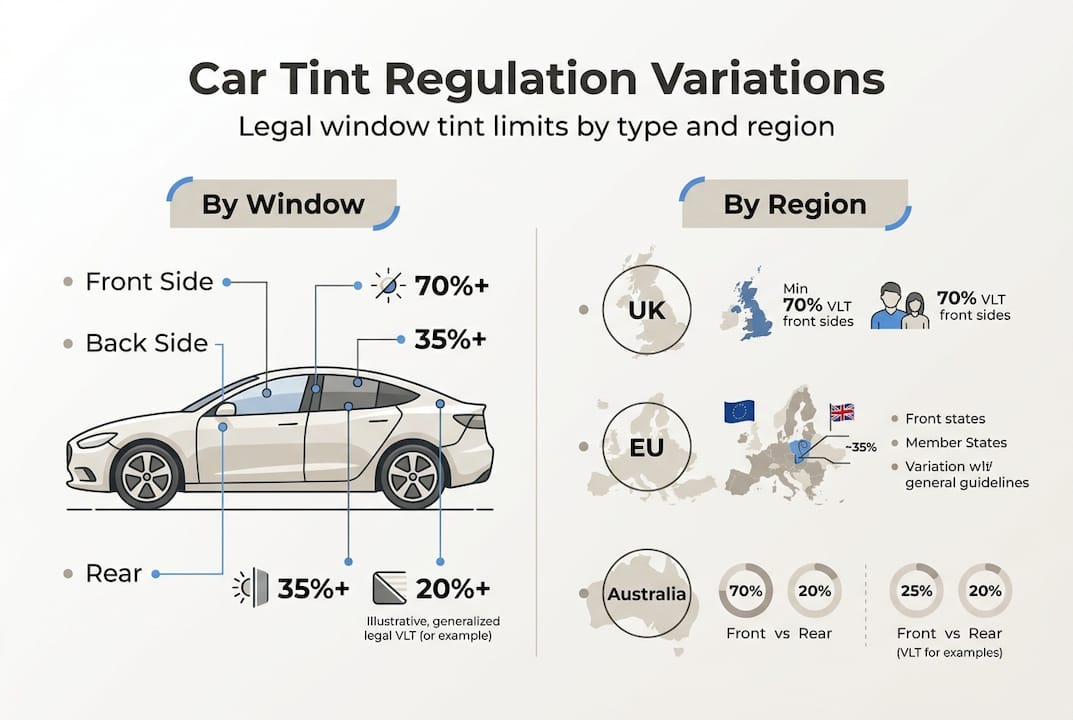
| Window type | Jurisdiction A (typical UK) | Jurisdiction B (typical EU) | Jurisdiction C (typical Australia) |
|---|---|---|---|
| Front windscreen | Light tint strip allowed (top 10%) | Light tint strip allowed (AS1 line) | Light tint strip allowed (top 10%) |
| Front side windows | 70% VLT minimum | 70% VLT minimum | 35% VLT minimum |
| Rear side windows | No restriction (if both mirrors present) | 70% VLT minimum | 20% VLT minimum |
| Back window | No restriction (if both mirrors present) | No restriction | 20% VLT minimum |
Front side windows consistently face the strictest regulations globally because they directly impact driver visibility and officer safety. Most jurisdictions require minimum 70% VLT, though some regions permit darker tints with specific mirror requirements. Professionals must recognise that even slight non-compliance on front windows triggers the highest enforcement priority.
Rear side windows and back windows receive more regulatory flexibility in many regions. This reflects reduced safety concerns for passenger area visibility whilst acknowledging privacy interests. However, variations remain significant, with some jurisdictions maintaining uniform standards across all windows whilst others permit complete darkness in rear positions.
Common exceptions and allowances include:
- Medical exemptions for light-sensitive conditions requiring documentation and official certification
- Commercial vehicle allowances permitting darker rear tints for cargo security
- Mirror requirements enabling darker rear tints when dual external mirrors are present
- Reflective coating restrictions limiting mirror-finish films regardless of VLT percentage
- Windscreen strip allowances permitting tinted sun bands above the AS1 line
Legal risks of non-compliance escalate rapidly. Minor violations may result in warnings or fix-it tickets requiring tint removal within specified timeframes. Repeated violations trigger escalating fines, potential vehicle impoundment, and insurance complications. For professionals, installing non-compliant tint exposes businesses to liability claims, regulatory penalties, and reputational damage that undermines client trust.
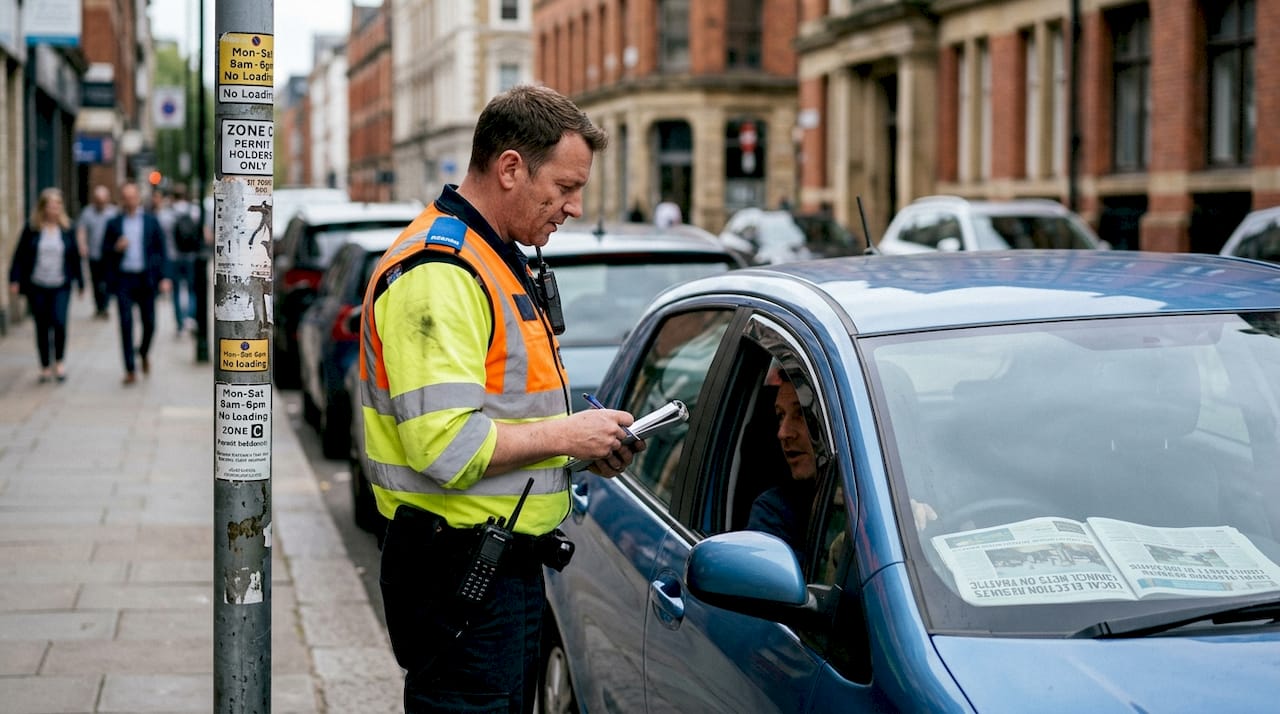
Regulations evolve constantly as legislators respond to safety data and enforcement challenges. Staying current with vehicle tint laws 2026 essential guide installers requirements prevents outdated practices from creating compliance failures. Annual regulatory reviews should form part of every professional’s business operations.
Reflective and mirror window tint vehicles face particular scrutiny. Many jurisdictions prohibit mirror-finish films entirely due to glare hazards for other drivers and reduced officer visibility during traffic stops. Even where permitted, reflectivity limits typically restrict coatings to minimal levels, requiring careful product selection and verification.
Tools and techniques to ensure car window tint compliance
Professional compliance demands precise measurement tools and systematic verification procedures. Guesswork and visual estimation expose businesses to regulatory violations and client disputes. Proper tint measurement tools and verification procedures are necessary for regulatory compliance and client trust, making equipment investment essential for serious installers.
Essential equipment for compliance verification:
- Professional-grade tint metres measuring VLT with ±2% accuracy or better
- UV radiation metres confirming ultraviolet protection claims for client assurance
- Calibration standards ensuring measurement accuracy over time
- Digital documentation systems recording pre-installation and post-installation readings
- Reference materials containing current regulations for all service jurisdictions
Tint metres function by passing light through the window assembly and measuring transmission percentage. Quality metres account for both film and glass, providing total VLT readings that match enforcement measurements. Cheaper consumer-grade metres often lack accuracy for professional use, creating false confidence in non-compliant installations.
Step-by-step compliance verification procedures:
- Measure factory glass VLT on all windows before film application to establish baseline readings
- Calculate maximum allowable film darkness by subtracting required final VLT from factory glass percentage
- Select appropriate film products ensuring combined VLT meets or exceeds legal minimums
- Verify film specifications against manufacturer documentation before cutting
- Measure post-installation VLT on every window to confirm compliance
- Document all readings with photographs, metre screenshots, and written records
- Provide clients with compliance certificates containing measurement data and legal references
- Retain records for minimum three years to address future disputes or audits
Record-keeping best practices protect businesses from liability whilst demonstrating professionalism. Comprehensive documentation should include vehicle identification details, installation date, film product specifications, pre-installation measurements, post-installation measurements, applicable regulations, and client acknowledgement signatures. Digital systems with cloud backup ensure records survive equipment failures or business transitions.
Pro Tip: Train staff regularly on tint measurement standards and legal updates to avoid costly errors. Quarterly training sessions reviewing regulatory changes and measurement techniques maintain team competency and reduce compliance risks.
Digital templates and software revolutionise precision in tint cutting and application. Traditional hand-cutting methods introduce measurement errors and material waste that undermine both compliance and profitability. Modern window tinting legal limits guide approaches integrate cutting software with regulatory databases, ensuring every pattern meets legal requirements whilst maximising efficiency.
Advanced software solutions offer pattern libraries containing thousands of vehicle-specific templates verified for accuracy. These systems reduce cutting time, minimise waste, and eliminate the measurement errors that cause compliance failures. Integration with window tinting regulations guide 2026 compliance tips ensures installers maintain current knowledge whilst executing precise installations.
Best practices for advising clients and managing compliance risks
Effective client communication forms the foundation of compliance risk management. Clients often request tint darkness levels exceeding legal limits, placing professionals in difficult positions. Setting realistic expectations protects both parties whilst maintaining business relationships and legal standing. Clear client communication and documented compliance policies reduce disputes and legal exposure, making communication skills as important as technical expertise.
Best communication practices for explaining legal restrictions:
- Present regulations as non-negotiable legal requirements rather than personal preferences or business policies
- Use visual examples showing legal versus illegal tint darkness to clarify differences
- Explain enforcement consequences including fines, removal requirements, and insurance complications
- Offer alternative solutions such as darker rear tints or ceramic films providing heat rejection without excessive darkness
- Provide written documentation outlining discussed regulations and client acknowledgement
Clients frequently underestimate enforcement likelihood or severity. Professionals must clearly communicate that traffic stops, vehicle inspections, and random enforcement checks all trigger tint measurements. Penalties vary by jurisdiction but commonly include fines ranging from £60 to £1,000, mandatory tint removal, and potential vehicle defect notices preventing road use until compliance is achieved.
Signed compliance disclaimers and informed consent documents protect businesses from liability when clients insist on non-compliant installations. These documents should explicitly state that the client requested tint darkness exceeding legal limits, understands the regulatory violations and potential penalties, and accepts full responsibility for consequences. Whilst such disclaimers do not eliminate installer liability in all jurisdictions, they demonstrate due diligence and informed client choice.
Monitoring regulatory updates requires systematic approaches. Subscribe to industry associations, regulatory bodies, and legal update services providing timely notifications of legislative changes. Quarterly reviews of mastering maximum legal window tint limits 2026 requirements ensure business policies reflect current law. Adjust service agreements, pricing structures, and client communications promptly when regulations change.
Strategies for managing non-compliance situations:
- Establish clear refund and re-tint policies addressing regulatory changes and enforcement actions
- Offer complimentary tint removal or replacement when installations prove non-compliant despite proper procedures
- Maintain professional liability insurance covering tint-related claims and regulatory penalties
- Document all client interactions regarding compliance discussions to demonstrate good faith efforts
- Develop relationships with legal counsel familiar with automotive regulations for dispute resolution
Dispute handling requires balanced approaches protecting business interests whilst maintaining client relationships. When clients face enforcement actions for compliant installations, documentation proving legal VLT levels resolves most situations. When non-compliant installations result from client insistence despite warnings, signed disclaimers and communication records demonstrate installer diligence. Professional handling of these situations preserves reputation even in difficult circumstances.
Staying informed through resources like car window tint law guide professional installers 2026 maintains competitive advantage. Clients increasingly value installers who demonstrate regulatory expertise and compliance commitment. This knowledge differentiates professional operations from amateur competitors whilst reducing business risks.
Enhance your window tinting service with AEONCUT solutions
Navigating complex tint regulations whilst delivering precise, efficient installations demands cutting-edge tools designed specifically for automotive professionals. AEONCUT software provides comprehensive pattern libraries, regulatory compliance features, and precision cutting capabilities that transform window tinting operations. The platform’s extensive database contains thousands of vehicle-specific templates, each verified for accuracy and updated regularly to reflect model variations.
AEONCUT’s master window tint software for precise installations approach eliminates measurement errors whilst reducing material waste. Cloud-based updates ensure you always work with current patterns and regulatory information, supporting compliance across multiple jurisdictions. AI-driven auto-nesting optimises material usage, improving profitability on every installation.
Pro Tip: Using these digital tools helps installers save time and maintain high-quality professional standards. The efficiency gains from precise patterns and automated cutting free up time for client consultation and quality control.
Explore how AEONCUT’s solutions can optimise your window tinting operations. Visit the AEONCUT homepage to discover subscription plans tailored for professional installers, or review window tinting regulations guide 2026 compliance tips for additional compliance insights.
Frequently asked questions
What are the legal tint limits for front side windows?
Legal tint limits for front side windows typically require higher visible light transmission, commonly 70% VLT minimum in most UK and EU jurisdictions, though specific percentages vary by region. Some areas permit darker tints when vehicles have dual external mirrors, whilst others maintain strict minimums regardless of mirror configuration. Professionals should verify local laws for specific percentages before installation, as mastering maximum legal window tint limits 2026 requirements differ significantly across jurisdictions. Front window regulations face strictest enforcement due to driver visibility and officer safety concerns.
How can I verify that my installed tint complies with regulations?
Verification involves using a professional-grade tint metre to measure visible light transmission through the complete window assembly, including both film and factory glass. Metres should provide ±2% accuracy or better, matching the precision of enforcement equipment used during traffic stops. Maintain documentation of all measurements, including pre-installation baseline readings and post-installation final VLT percentages. Regular calibration of measurement tools ensures continued accuracy, whilst following car window tint law guide professional installers 2026 verification procedures provides systematic compliance assurance.
Are mirror or reflective tints allowed on vehicles?
Mirror or reflective tints are often restricted or prohibited in most jurisdictions due to safety concerns about glare affecting other drivers and reduced officer visibility during traffic stops. Where permitted, reflectivity limits typically restrict coatings to minimal levels well below true mirror finishes. Some regions allow slight metallic appearance without mirror-like reflection, whilst others ban any reflective properties entirely. Professionals must check local laws before installation, as mirror window tint vehicles regulations vary significantly and violations often trigger immediate enforcement actions.
Recommended
- Window tinting regulations guide 2026: compliance tips – AEONCUT PPF Pre-cut Cutting software
- Car Window Tint Limit – Why Compliance Matters – AEONCUT PPF Pre-cut Cutting software
- Car window tint law guide for professional installers 2026 – AEONCUT PPF Pre-cut Cutting software
- Complete Guide to Window Tinting Legal Limits – AEONCUT PPF Pre-cut Cutting software